

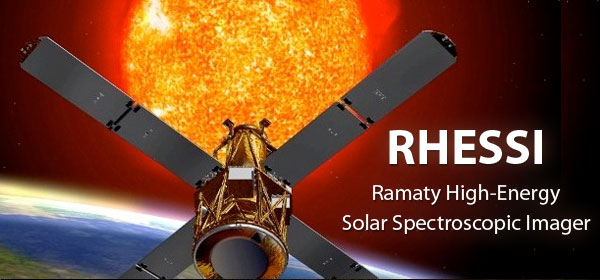
RHESSI
Ramaty High-Energy Solar Spectroscopic Imager
The Primary Mission Objective is to explore the basic physics of particle acceleration and energy release in solar flares.
Science Objectives
Solar
- Determine the frequency, location, and evolution of impulsive energy release in the corona
- Study the acceleration of electrons, protons, and heavier ions in flares
- Study the heating of plasma to tens of millions of degrees and determine its relationship to particle acceleration
- Study the propagation and evolution of energetic particles in flares
- Determine the relative abundances of accelerated and ambient ions in flares
Non-Solar
- Obtain images and spectra of the Crab Nebula with 2 arcsecond spatial resolution and ~1 keV spectral resolution
- Detect and obtain high resolution spectra of gamma-ray bursts and cosmic and terrestrial transient sources over a large fraction of the sky
- Search for cyclotron line features in gamma-ray bursts and cosmic transient sources
- Obtain high resolution spectra and search for line features in steady X-ray and gamma-ray sources
Primary Observations
Simultaneous, high resolution imaging and spectroscopy of solar flares from 3 keV X-rays to 17 MeV gamma rays with high time resolution
Expected Numbers of Flares:
- Tens of thousands of microflares
- Over a thousand X-ray flares with crude imaging and spectra to >100 keV
- Hundreds of flares with >1000 counts per second above 20 keV, allowing spatial changes to be followed on timescales of 0.1 seconds.
- Tens of flares sufficiently intense to allow the finest possible imaging spectroscopy
- Up to 100 flares with the detection of gamma-ray lines
- Tens of flares with detailed gamma-ray line spectroscopy and the location and extent of the source determined to ~40 arcseconds
Mission Details
 Mission Class
Small Explorer (SMEX)
Launch
Date: February 5, 2002
Time: 3:58 PM EDT
Vehicle: Orbital Sciences Corporation (OSC) Pegasus XL
Site: L1011 aircraft takes off from Kennedy Space Center
Orbit
Circular
Altitude: 600 km (373 miles)
Inclination to the equator: 38 degrees
Spacecraft Pointing
Spin stabilized
Spin axis within 0.2 degrees of Sun center
Spin rate:15 revolutions per minute
Ground Stations
Primary
University of California, Berkeley
Backup
Wallops Flight Facility, Virginia
Santiago, Chile
Weilheim, Germany
Operations Lifetime
2 years (3 years desirable)
Spectroscopy
Detectors
Nine segmented, hyperpure germanium crystals
Cooled to ~75 K (-198 degrees Celsius)
Energy Range
~3 keV – ~17 MeV
Spectral Resolution
~1 keV (FWHM) in the front segment up to ~100 keV
~3 keV in the rear segment up to ~1 MeV increasing to ~5 keV at 20 MeV
Imaging
Technique
Fourier-transform imaging
9 rotating modulation collimators (grid pairs)
Field of View
Full Sun (~1 degree)