
✨ Everyone says “spring is here” and moves on. But the March equinox is hiding some of nature’s strangest phenomena — 4-day sunrises, both Poles bathed in daylight at once, and an aurora supercharger you probably don’t know about. Here’s what really happens at the March Equinox 2026…
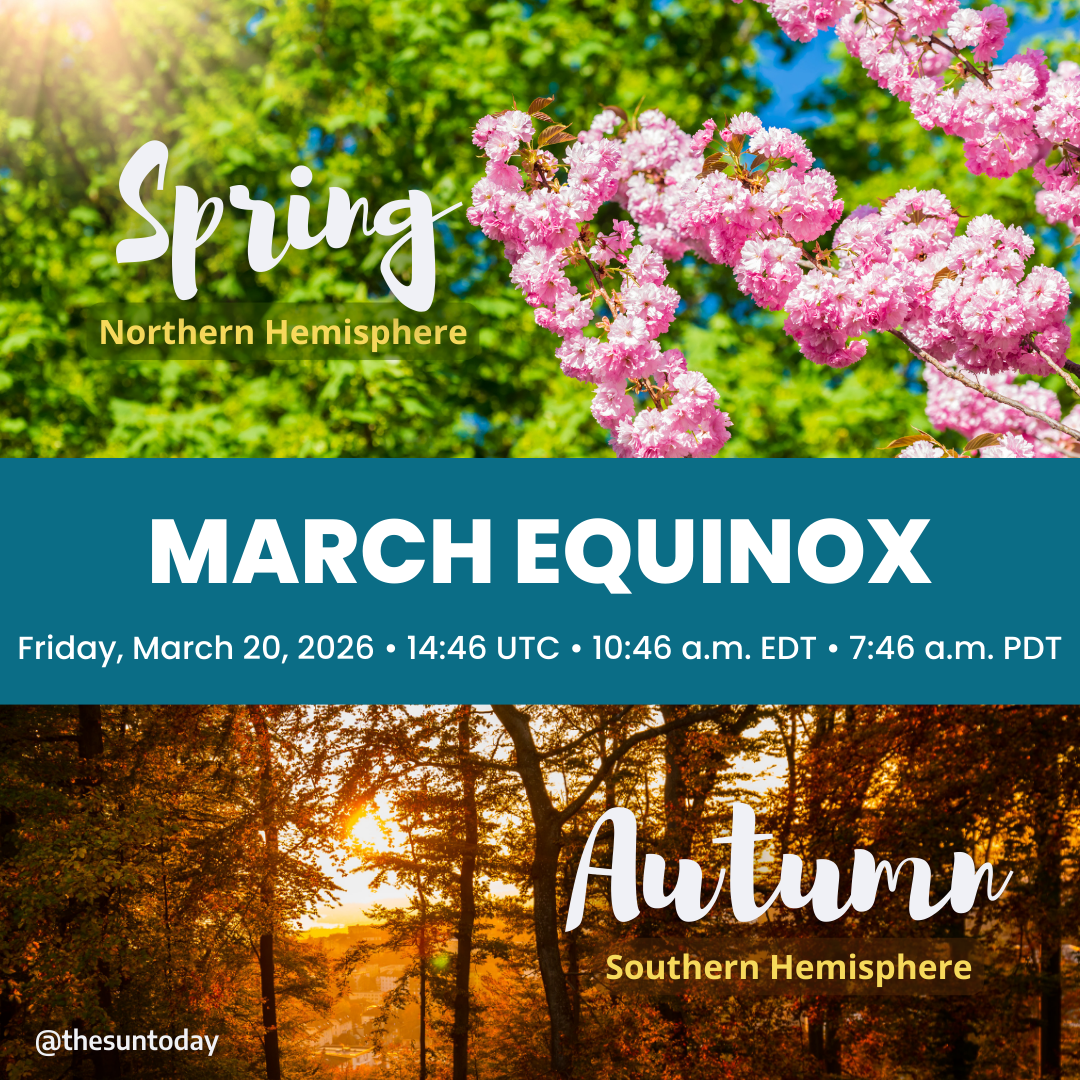
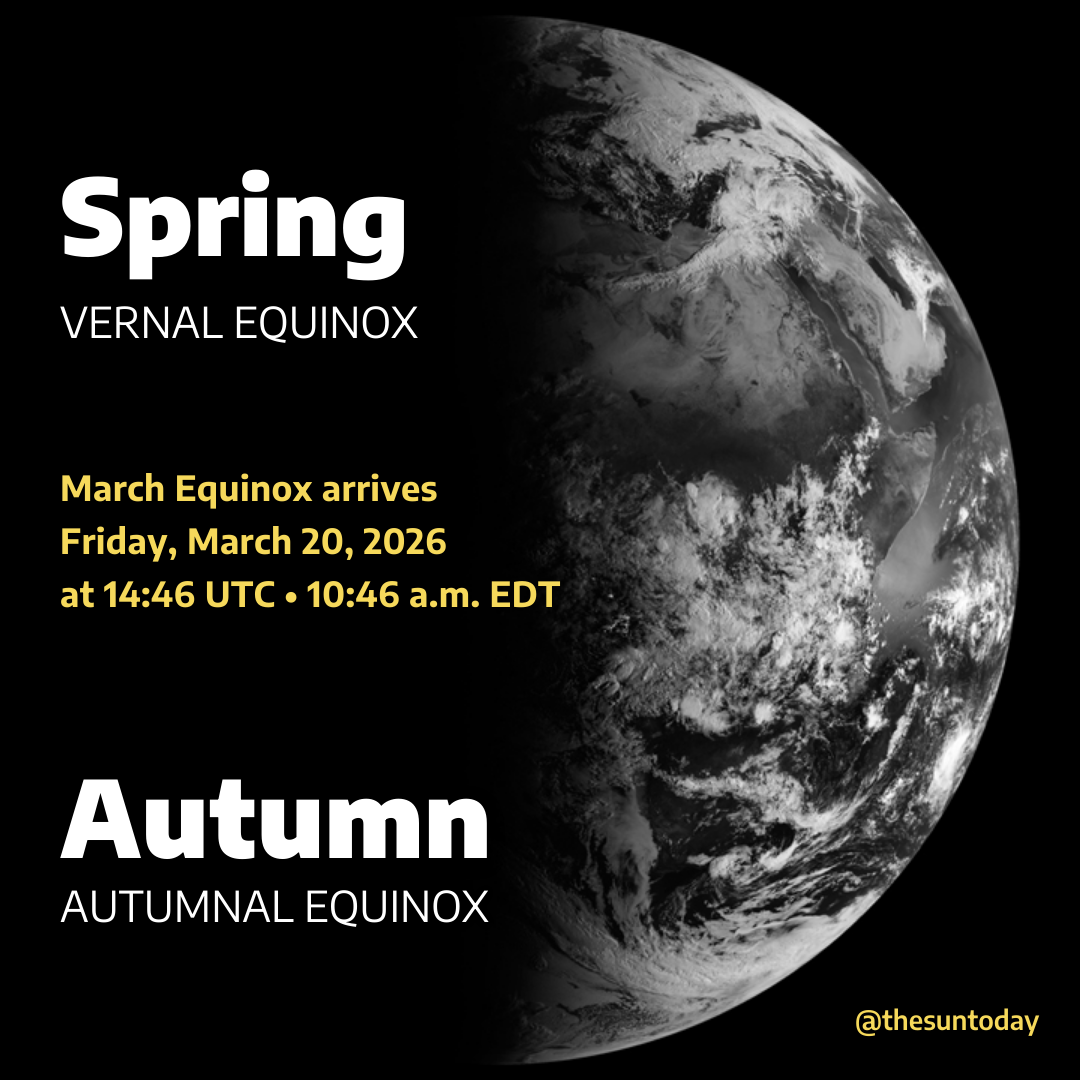
Mark your calendars: The March Equinox arrives on Friday, March 20, 2026 at 14:46 UTC (10:46 AM EDT | 7:46 AM PDT). 🌍🌸☀️🍂
Weird & Wonderful Things
About The March 2026 Equinox
- 🌅 Longest sunrise & sunset on Earth: At the Poles, each lasts about 4 days, not minutes. MORE »
- 🔄 Both Poles in daylight: For a few days, the Sun hovers so both North & South Poles see it at once. MORE »
- 🌞 Day ≠ Night: Earth’s atmosphere bends sunlight, so days are actually a little longer than nights.
- 🧭 Look the “wrong” way: In the Northern Hemisphere, face south to see the Sun’s arc; in the Southern Hemisphere, look north. MORE »
- 🌑 Bonus sky shows in 2026: A total lunar eclipse just 17 days before + a Venus–Saturn conjunction on March 8.
- 🌌 Aurora boost: Earth’s tilt makes the northern & southern lights more active around the equinoxes.
The equinox isn’t just an event on the calendar — it’s a
global sky performance with quirks you won’t hear in most explainers.
This is the moment when day and night are nearly equal everywhere on Earth…sort of.
The word equinox comes from Latin meaning “equal night.” Twice a year (March & September), the Sun shines directly over Earth’s equator. This marks the change of seasons:
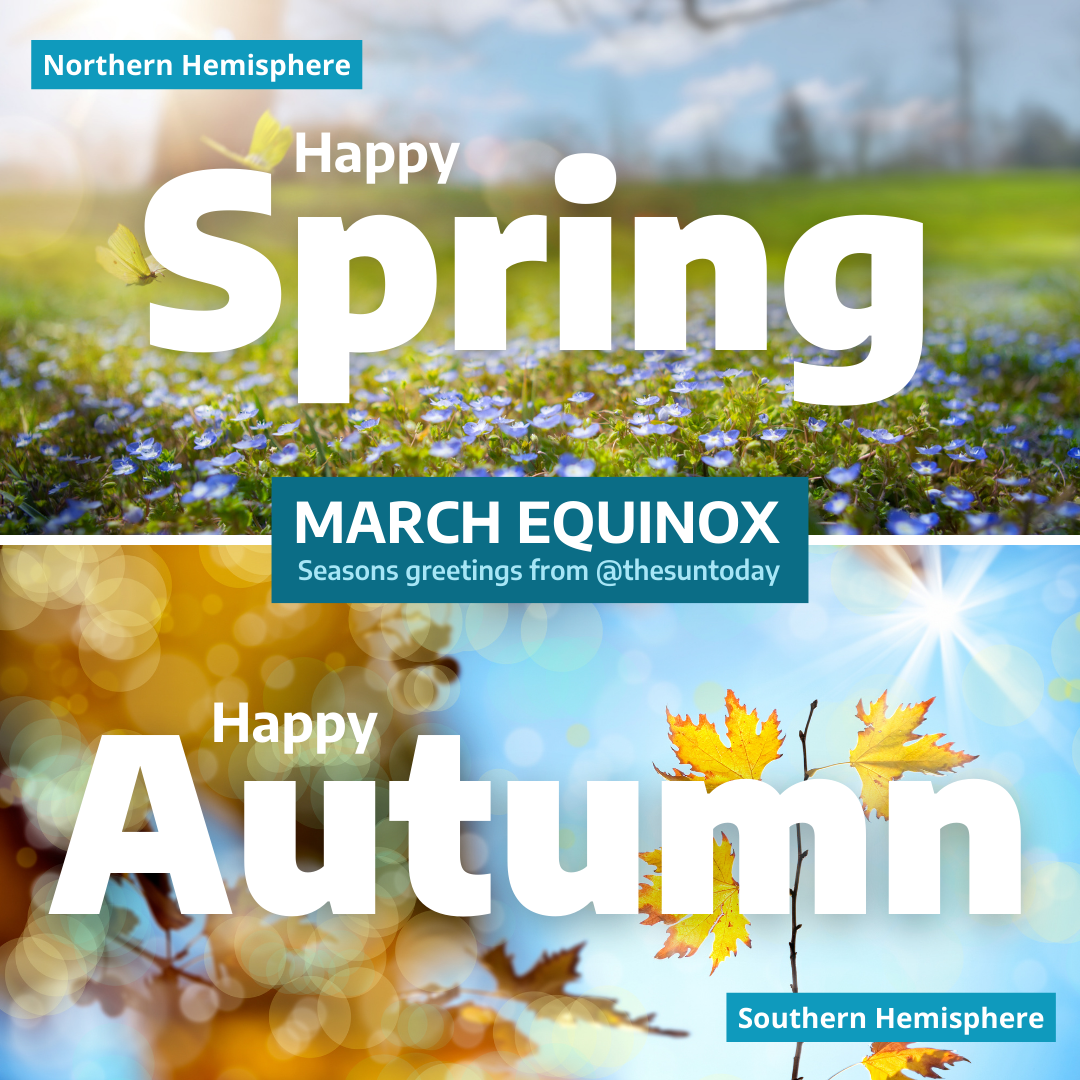
- Spring begins in the Northern Hemisphere. 🌸
- Fall begins in the Southern Hemisphere. 🍂
The March Equinox is when the Sun crosses directly above Earth’s equator heading northward, marking the start of a new astronomical season: spring in the Northern Hemisphere and autumn in the Southern Hemisphere. Around this date, day and night are close to equal length everywhere on Earth. They’re not perfectly equal, though — Earth’s atmosphere bends sunlight, letting us see the Sun before it has truly risen and after it has actually set.
The Poles are strange…keep reading to learn why!
Meteorologists define the seasons a little differently. Meteorological “spring” and “fall” began back on March 1, but the astronomical seasons are tied to the motions of the Sun. The next seasonal shift comes at the June solstice, when summer begins in the north and winter in the south.
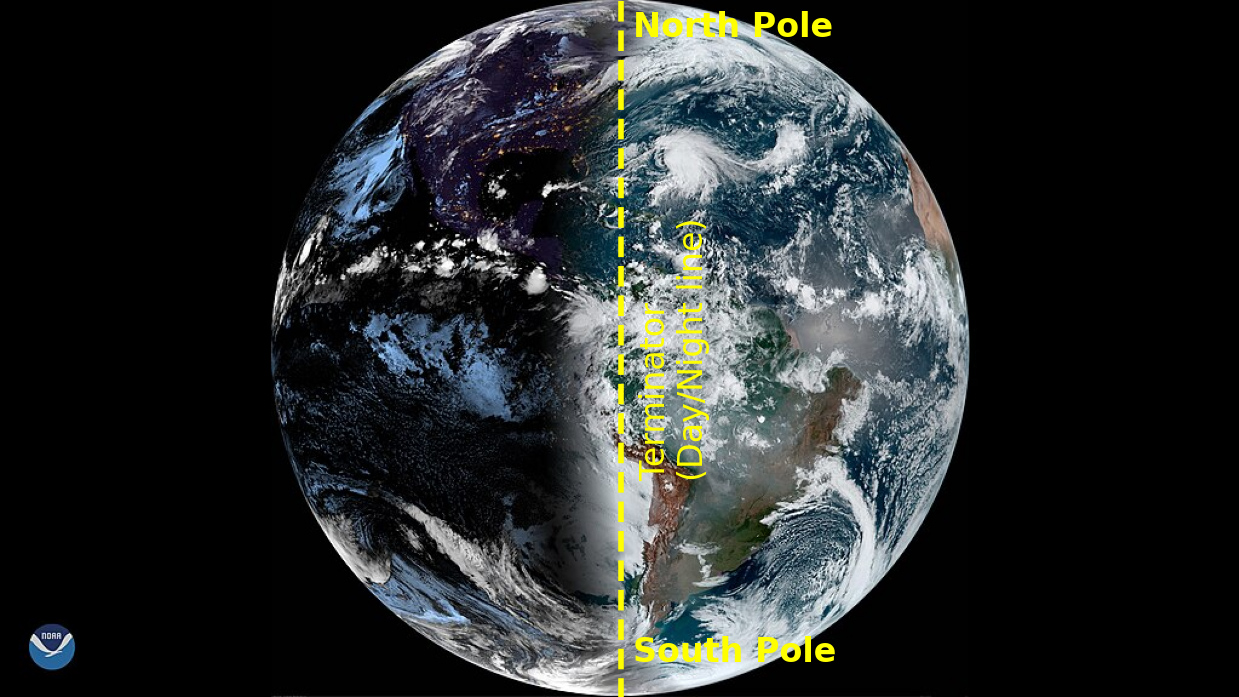
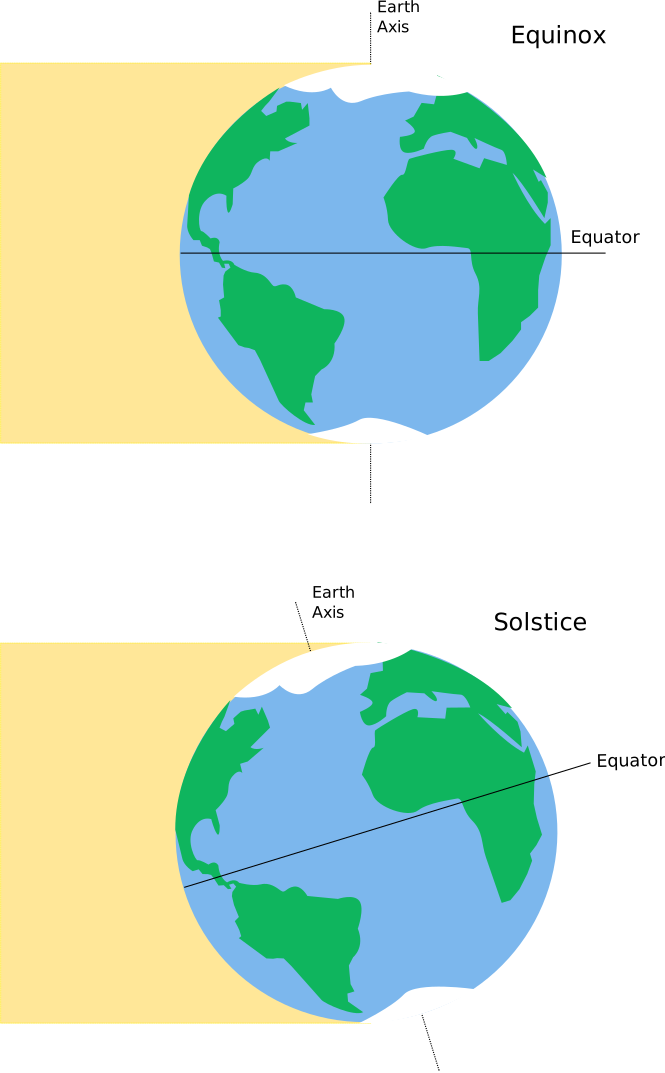
On the Equinox, the terminator line (the shadow boundary between day and night) is running north pole → south pole in a straight line.
- Equinox = the day when Earth’s Equatorial Plane and Orbital Plane line up at their crossing.
- This “cancels out” the effect of Earth’s tilt on sunlight distribution.
- The result is what you see: the terminator (day/night line) runs straight from pole to pole.
- From this spacecraft perspective, the Sun is shining equally on both hemispheres — no one tipped closer or farther.
- From the equator, the sun is directly overhead at solar noon.
- From the poles, the sun is circling 360 degrees around the horizon.
This only happens at the equinox, because the Sun is aligned with the equator. On any other day of the year, the terminator is tilted relative to the poles, because one hemisphere is leaning toward the Sun (summer) and the other is leaning away (winter). The image below shows this change.
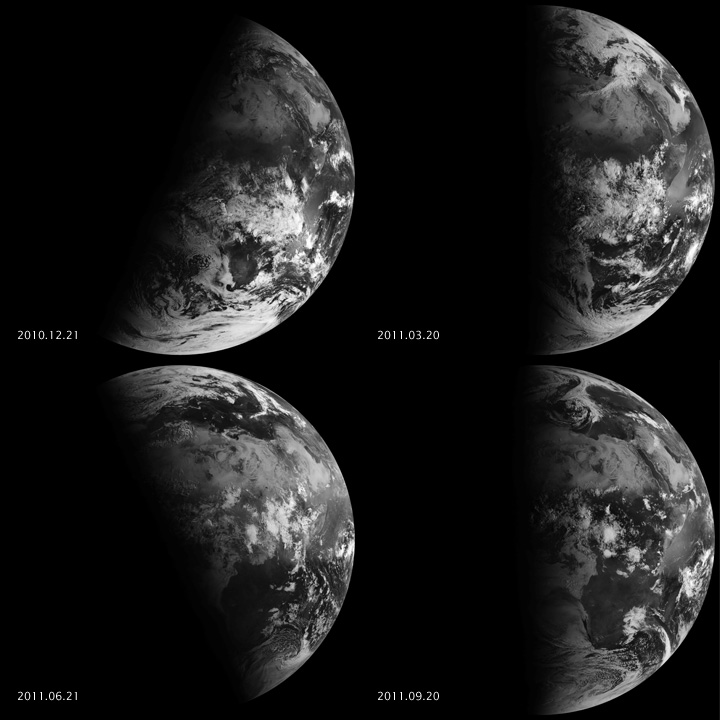
🌍 Fun Sun–Earth Geometry
The equinox happens at the exact moment when the center of the Sun crosses the celestial equator (the projection of Earth’s equator into space). This means the Sun is positioned directly above Earth’s equator.
- Earth’s equator = the line halfway between the poles.
- Equatorial plane = that same line extended outward into space as a flat sheet.
- Celestial equator = the equatorial plane extended into the sky.
- Orbital Plane = the flat sheet defined by the Earth’s orbit around the Sun
- Ecliptic = the Sun’s apparent yearly path in the sky, defined by Earth’s orbital plane.
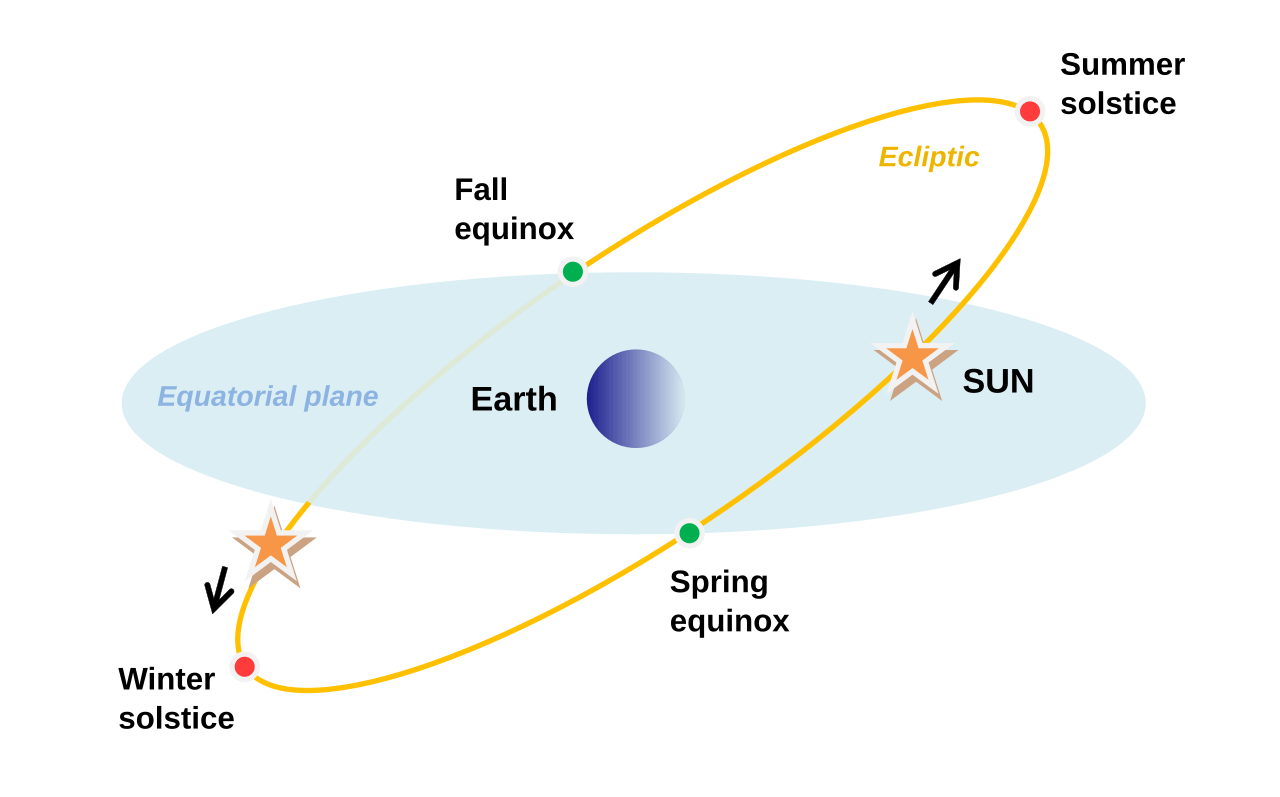
The celestial equator and the ecliptic are tilted relative to each other by 23.5° (Earth’s axial tilt). The March & September equinoxes are the two points where these two planes cross:
- March equinox → northward crossing (spring in the Northern Hemisphere).
- September equinox → southward crossing (fall in the Northern Hemisphere).
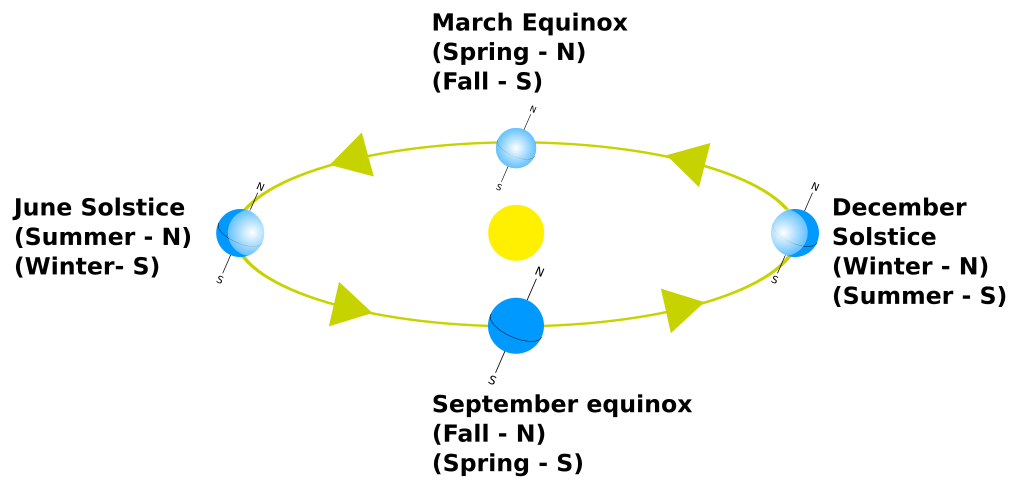
Equinox = Point + Event + Day
- Point → where the ecliptic and celestial equator intersect.
- Event → the moment the Sun’s center passes that point.
- Day → what we mark on the calendar.
We use the center of the Sun in this definition because the Sun is a disk ~0.5° wide (this is its width in the sky in degree and for comparison the full moon is also ~0.5° wide.) Its top edge rises a few minutes before the center, and its bottom edge sets a few minutes after. Using the center keeps the definition precise and consistent for everyone on Earth.
☀️ Viewing the Sky from Earth 👀
The only constant rule: everything rises in the east and sets in the west (with tiny exceptions near the poles). That’s because of Earth’s rotation. Things can feel confusing because the patterns are opposite in the hemispheres. But the simple rule of thumb is:
👉 Face the direction where Earth’s equator is located. Then look up to see the Sun’s daily arc.
- In the Northern Hemisphere, look south (toward the equator).
- In the Southern Hemisphere, look north (toward the equator).
👉 If you are already standing on Earth’s equator, just look up.
- At the Equator, you’re standing where you need to look :-), so look up
- The Sun shifts — north of you from March to September, south of you from September to March, and directly overhead at the equinoxes.
🌙 What about the Moon?
The Moon follows almost the same rules as the Sun because its orbit lies close to the ecliptic:
- Northern Hemisphere → mostly in the southern sky.
- Southern Hemisphere → mostly in the northern sky.
- Equator → alternates north/south depending on the month.
🌌 What about the planets?
- Mercury and Venus (inner planets) always stay close to the Sun in the sky, so they follow the Sun’s seasonal north/south shifts.
- Outer planets (Mars, Jupiter, Saturn, etc.) also track near the ecliptic, so they too appear north or south of the celestial equator depending on the year.
- BONUS: Venus and Saturn had a stunning conjunction on March 8, 2026 — appearing within ~1° of each other in the evening sky!
👉 From either hemisphere, you can see all the planets — but whether you look north or south depends on your latitude and the season.
📅 For the March 2026 Equinox, The Sun…
- Rises at the North Pole
- Is directly overhead at solar noon at the Equator
- Sets at the South Pole
To describe where the Sun is, we use Azimuth = the compass direction of the Sun (0° = north, 90° = east, 180° = south, 270° = west). In order of events…
☀️ At the North Pole
- The Sun rises about 2 days before the equinox.
- Sunrise = when the apparent top edge of the Sun appears above the horizon.
- Over the next ~4 days, the Sun gradually clears the horizon until its full disk is visible.
- From then on, the Sun never sets, but spirals slowly upward.
- Each 24 hours, it makes one complete 360° loop around the horizon.
- Its altitude increases a little bit each day until the June solstice, when it reaches its highest point.
- After that, the spiral reverses — the Sun slowly descends, looping daily until it sinks below the horizon at the September equinox.
- Sunrise & sunset times at 89°59’N, 0°00’E
☀️ At the Equator
The “textbook equinox” experience — equal day and night, and the Sun passing right overhead.
- On the equinoxes, the Sun rises almost exactly straight up from due east (90° azimuth) and sets straight down at due west (270° azimuth).
- At local noon, the Sun is directly overhead (90° altitude).
- Day and night are each about 12 hours long.
- The equinox moment is when the center of the Sun crosses the celestial equator — the official astronomical definition.
- Sunrise & sunset times in Quito, Ecuador
The difference between March and September equinoxes is which way the Sun moves afterward:
- March equinox → drifting northward (into the Northern Hemisphere).
- September equinox → drifting southward (into the Southern Hemisphere).
❄️ At the South Pole
- The Sun sets around 2 days after the equinox.
- Sunset = when the apparent top edge of the Sun slips below the horizon.
- After that, the Pole enters months of twilight, followed by polar night.
- NOAA researchers at the South Pole Observatory witness just one sunrise and one sunset per year. At this equinox, they’re watching the Sun disappear for six months.
- Sunrise & sunset times at the South Pole
In September, everything is reversed.
CREDIT: Click on each video to view details from
🌅 The Longest Sunrise and Sunset on Earth 🌅
If you love sunrises and sunsets, the Poles are epic. The good news: they are multi-day events. The bad news: you only get one of each per year!
Why do they take so long?
- Sunrise begins when the top edge of the Sun peeks above the horizon.
- Sunset ends when that same top edge finally dips below.
- At most places on Earth this takes just a few minutes.
- At the Poles, the Sun is skimming sideways along the horizon, so it takes about 4 days for the full disk to “rise” or “set”.
EQUINOX WEIRDNESS: Right now, both the North Pole and South Pole are in “daylight” – because of this transition. The sun is big & bright, so even having a little bit of it above the horizon = daylight!
🌞 Why Both Poles Can Still Be in “Daylight”
- Atmospheric refraction → Earth’s atmosphere bends sunlight, so we see the Sun even when it’s a little below the horizon (by about 0.5°).
- Finite size of the Sun → the Sun isn’t a point, it’s a disk about 0.5° wide. Even if the center is at the horizon, the upper half is still visible.
- Because of those effects, both poles actually get a few days of “daylight” around the equinox instead of a sharp instant flip to darkness.
- At equinox, both poles can experience daylight at the same time, even though geometrically the Sun is exactly on their horizon.
- What we call “daylight” doesn’t require the whole Sun to be high in the sky — just a sliver above the horizon (plus refraction) is enough to light things up.
🔄 How the timing works
- North Pole sunrise (start) and South Pole sunset (end) are part of the same drawn-out event.
- At the moment of the equinox, half the Sun’s disk is visible at both Poles.
- The full event STARTS ~2 days before (Sun just peeks up at the North Pole).
- At the same time, it starts to set at the South Pole.
- The full event ENDS ~2 days after (last sliver disappears at the South Pole).
- At the same time, the Sun is now above the horizon at the North Pole!
So when people say everywhere on Earth has “equal daylight” or “12 hours of night & day” on the Equinox, you now know it’s not true at the Poles!
You need to go to the Equator to see that!
CREDIT: Click on each video to view details from
🌍 Other places on Earth
At the Poles, you see the entire circle of the Sun’s slow spiral.
Everywhere else, you only see part of the Sun’s path — the daytime arc above your horizon. Each day, the Sun is either gaining or losing altitude in the sky, and the equinox is the halfway point in that climb or descent.
The alignment of sunrise at 90° due East and sunset at 270° due West is offset by a few days.
- The further north you go, it shifts BEFORE the March Equinox.
- The further south you go, it shifts AFTER the March Equinox.
- Look up locations at TimeandDate.com to see various times.
👉 Fun fact: Day and night aren’t exactly equal on the equinox because of Earth’s atmosphere bending sunlight (refraction) and the size of the Sun’s disk. But they’re pretty close!
🌍 Daylight Change Around the March Equinox
Click on the location name for the exact timing!
| Location | Latitude | Equinox Day Length | Change per Day (after equinox) | Seasonal Swing | Notes |
|---|---|---|---|---|---|
| NORTH POLE | 90°N | 24 hours | Gaining sunlight | 24h night in winter → 24h daylight in summer | Sun up on the March Equinox, then continuous daylight for 6 months. |
| Utqiaġvik (Barrow), Alaska | 71°N | ~12h 28m | 9+ min gained | 24h night in winter → 24h daylight in summer | On the March equinox the Sun skims the horizon; by mid-May it won’t set for ~2 months. Long twilight, dramatic return of daylight. |
| Fairbanks, Alaska | 65°N | ~12h 21m | 6:37 min gained | 3½h (Dec) → 21h (June) | Dramatic seasonal change — the fastest daylight gains of the year. |
| , Massachusetts | 42°N | ~12h 12m | 2:50 min gained | 9h (Dec) → 15h (June) | Noticeable but moderate swing. Spring forward! |
| Miami, Florida | 26°N | ~12h 09m | 1:30 min gained | 10½h (Dec) → 13½h (June) | Mild seasonal change. |
| Quito, Ecuador | ~0° | ~12h 06m | < 1s change | ~12h year-round | Almost no seasonal change. |
| Sydney, | 34°S | ~12h 10m | 2:20 min lost | 14½h (Dec) → 10h (June) | Heading into autumn — days are shortening. |
| SOUTH POLE | 90°S | 24 hours | Losing sunlight | 24h daylight in summer → 24h night in winter | Sun down on the March Equinox, then darkness for 6 months. |
How much sunlight do the seasons bring?
- Poles: “All in” — months of day, months of night.
- High latitudes: fastest changes, dramatic seasonal contrast.
- Mid latitudes: moderate, noticeable seasonal swings.
- Tropics & equator: minimal change — days are always about 12 hours.
🌟 5 Seasonal Sky Facts
1. The March Equinox is the official start of a new season
- Spring in the Northern Hemisphere 🌸
- Autumn in the Southern Hemisphere 🍂
2. Day and night aren’t exactly equal
Earth’s atmosphere bends sunlight and the Sun’s disk isn’t a single point. This makes the day a little longer than the night. The true “equal day and night” (called the equilux) happens a few days before or after the equinox.
3. The longest day doesn’t happen on the solstice
Thanks to Earth’s tilted axis and elliptical orbit, sunrise and sunset shift in quirky ways. That means the solstice isn’t always the exact day with the longest daylight.
4. Meteorological seasons are different from astronomical seasons
Meteorologists keep things simple by starting seasons on the 1st of March, June, September, and December. Astronomers tie the seasons to the equinoxes and solstices — the actual motions of the Sun and Earth.
5. It’s a global event.
Around the equinox, the Sun rises due east and sets due west for almost everyone on Earth…this post explains a few weird details about this. Still, no matter where you live, this moment connects the entire planet under one sky. 🌍
🌟 Sky Highlights Around the Equinox
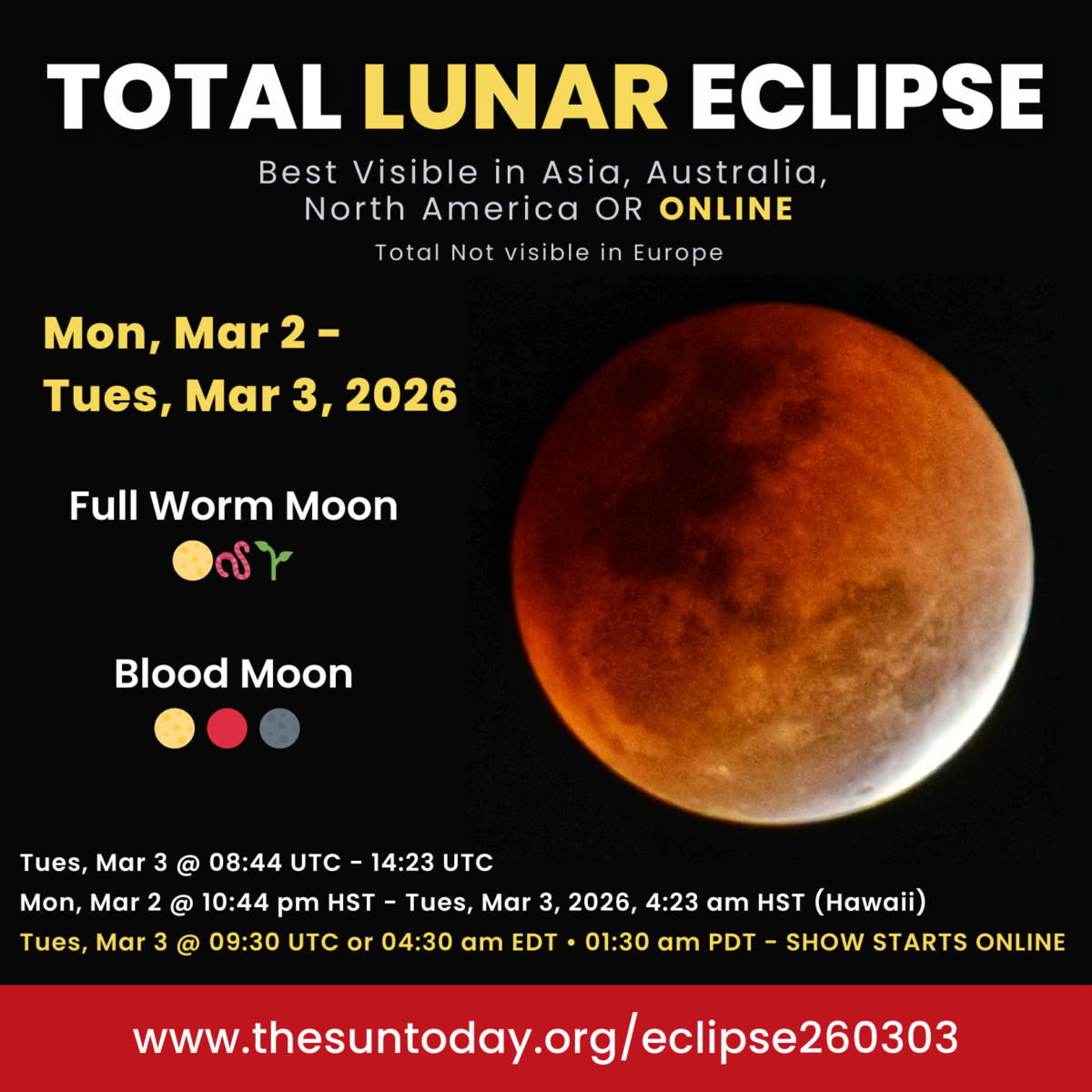
🌑 Total Lunar Eclipse — March 3, 2026
Just 17 days before the equinox, the Moon turned deep red during a total lunar eclipse visible across the Pacific Rim. This was the last total lunar eclipse until late 2028 — hopefully you caught it! Read more here →
🪐 Venus–Saturn Conjunction — March 8, 2026
Venus and Saturn appeared within roughly 1 degree of each other in the evening sky — about the width of a thumb held at arm’s length. A beautiful naked-eye pairing! More info →
🔴 Mercury–Mars Conjunction — March 14, 2026
Mercury and Mars met low in the pre-dawn sky. Mars (magnitude ~1.1) was the brighter of the pair, with Mercury (magnitude ~2.5) nearby. Best seen from the Southern Hemisphere where both rose higher above the horizon before sunrise.
🌌 Aurora Boost at the Equinoxes
Did you know the aurora are often stronger and more frequent around the equinoxes? More info →
- The March equinox isn’t just about balance — it also supercharges the auroras.
- Earth’s tilted magnetic field lines up in just the right way at the equinoxes.
- This alignment makes it easier for solar wind to stream into our atmosphere.
- Result: stronger, more frequent northern and southern lights (the Russell–McPherron effect).
- With Solar Cycle 25 still near its peak, conditions are primed for spectacular aurora displays!
👉 Translation: Equinox season = one of the best times of year to watch the skies glow.
👀 Looking Ahead in 2026
This is just the beginning of a spectacular year for sky watchers:
- August 12, 2026 — Total Solar Eclipse visible from Greenland, Iceland, and northern . The headline celestial event of 2026.
- August 28, 2026 — Partial Lunar Eclipse.
- October 4, 2026 — Saturn at opposition, its brightest for the year.
🌸🍂 Seasons Greetings from the Sun
The March equinox reminds us how the Sun drives Earth’s seasonal rhythms:
- Cherry blossoms and renewal in the north. 🌸
- Harvest and golden light in the south. 🍂
Wherever you are, take a moment to enjoy your changing skies.
CREDITS: , NOAA, EarthSky, TimeandDate.com, and owners of videos that have been embedded – please click on them for full details.