With the approaching final launch (scheduled July 8, 2011) of the Space Shuttle Atlantis and the end to the 30 plus year Space Shuttle program, it is a good time to take a brief fond farewell look at the Shuttle program’s incalculable contribution to modern solar physics.
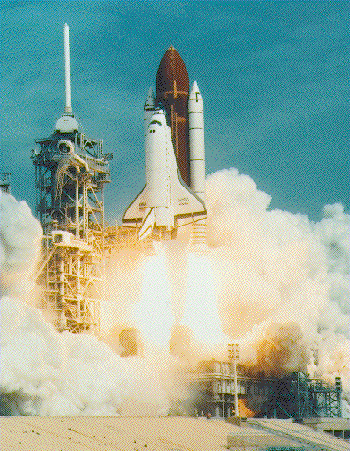
The Shuttle Atlantis launch with the Compton Gamma-ray Observatory
There are many aspects of the Space Shuttle program both directly and indirectly that have impacted solar physics as well as numerous other fields of science and technology. I could never do it justice here so I am focusing on 3 impacts to solar physics. Three programs stand out in my mind. The Solar Maximum Mission (SMM), the SPARTAN project and the Compton Gamma-ray Observatory (CGRO).
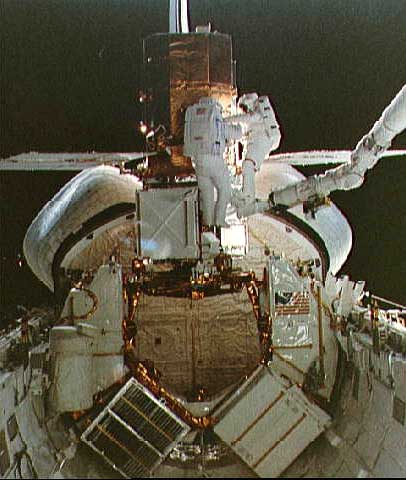
The Solar Maximum Mission being repaired in the bay of the shuttle Challenger
Solar Maximum Mission (SMM)
SMM mission launched 14 February 1980 on the rising phase of a solar cycle. It had instruments to study solar flares through imaging and spectroscopy over several parts of the light spectrum from UV up to gamma rays. It provided unique and pioneering observations of solar flares for 8+ years, almost an entire solar cycle. In 1984, space shuttle Challenger (STS-41) and her crew performed a dramatic rescue to fix SMM’s damaged stabilization system enabling 6 more years of solar observations.
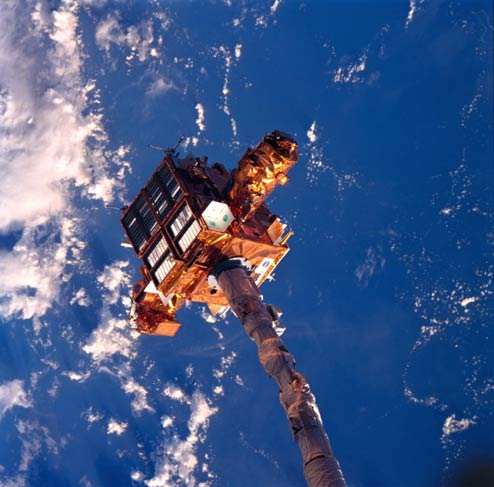
The SPARTAN instrument being deployed by the space shuttle robot arm
SPARTAN
The SPARTAN mission was an instrument package designed to study the outer corona of the sun. It was part of the shuttle programs special payload program and was successfully deployed with the shuttles robotic arm from the shuttle bay on 3 separate occasions, STS-56, STS-64, and STS-69.
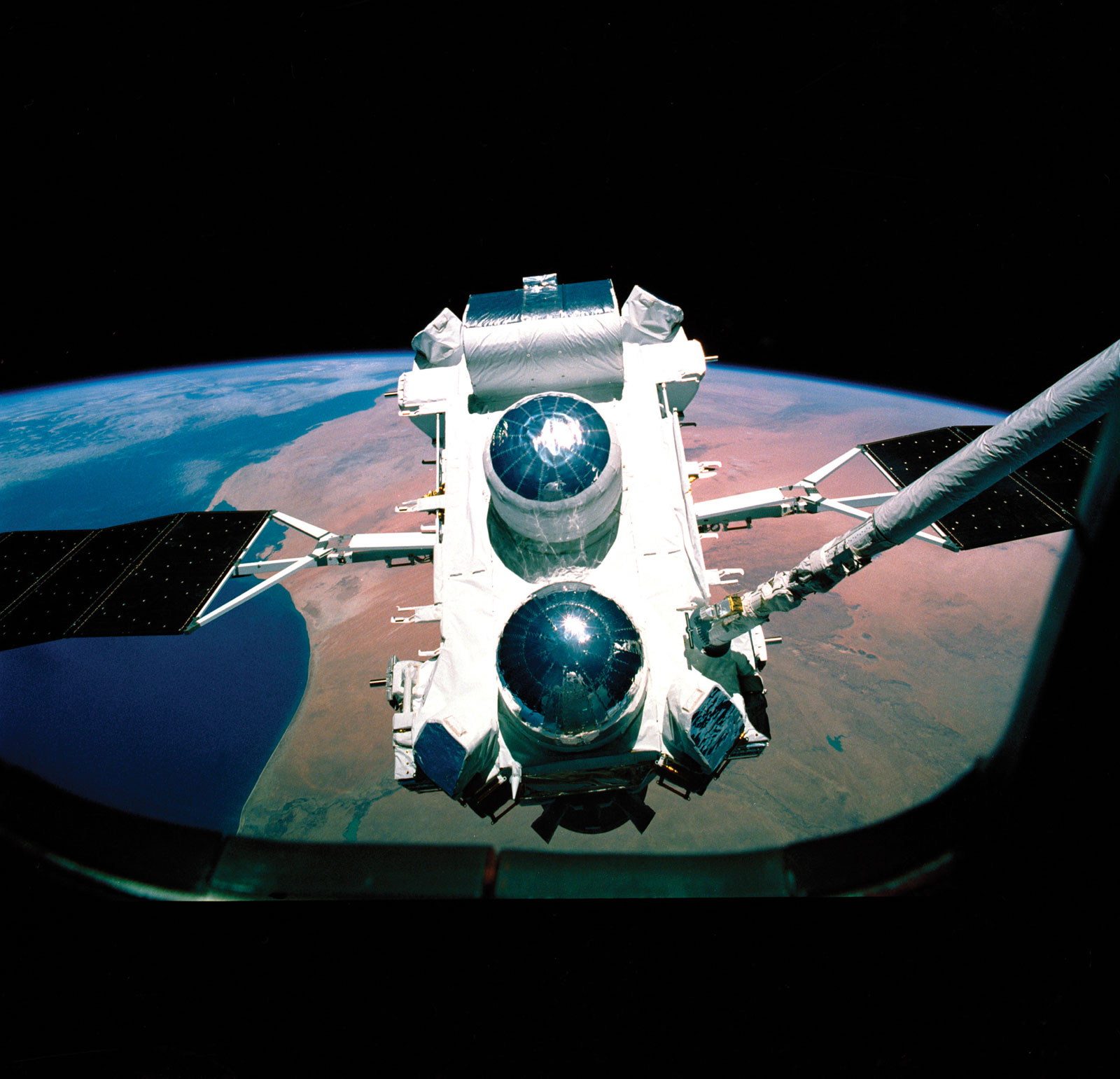
The Compton Gamma-ray Observatory being deployed from the Space Shuttle Atlantis payload bay
Compton Gamma-ray Observatory (CGRO)
On April 1991, space shuttle Atlantis launched one of NASA’s great observatories (such as Hubble), the Compton Gamma-ray Observatory (CGRO). CGRO had 4 sets of instruments that together observed from X-rays to gamma rays spanning 6 decades of the light spectrum. CGRO studied the entire universe from the local universe including the Sun out to the most distant objects. CGRO provided many new and unique observations of the Sun. I have a person tie to CGRO because my Ph.D. work was on high-energy aspects of solar flares using data from CGRO.