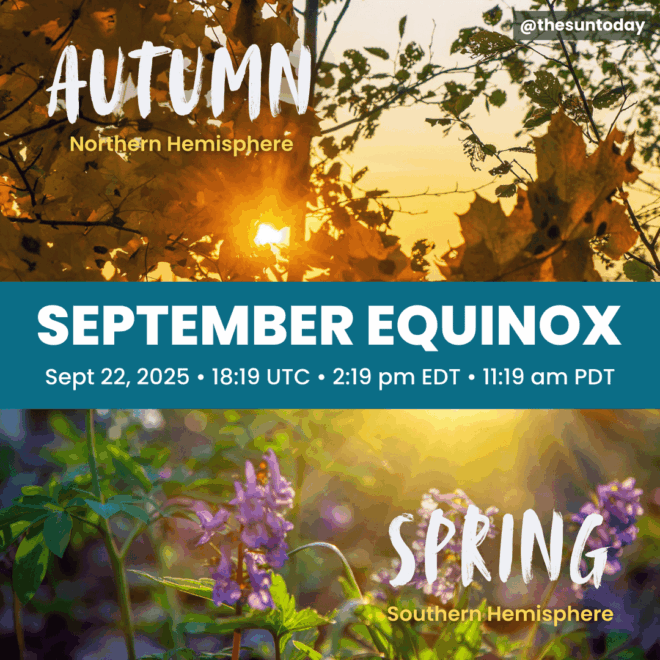

✨ Most solstice posts say “longest day of the year.” But the real story is far more interesting — with a Sun that never sets, a Sun that seems to pause in the sky, and cosmic surprises you might not expect. Here’s what really happens at the June Solstice 2026…
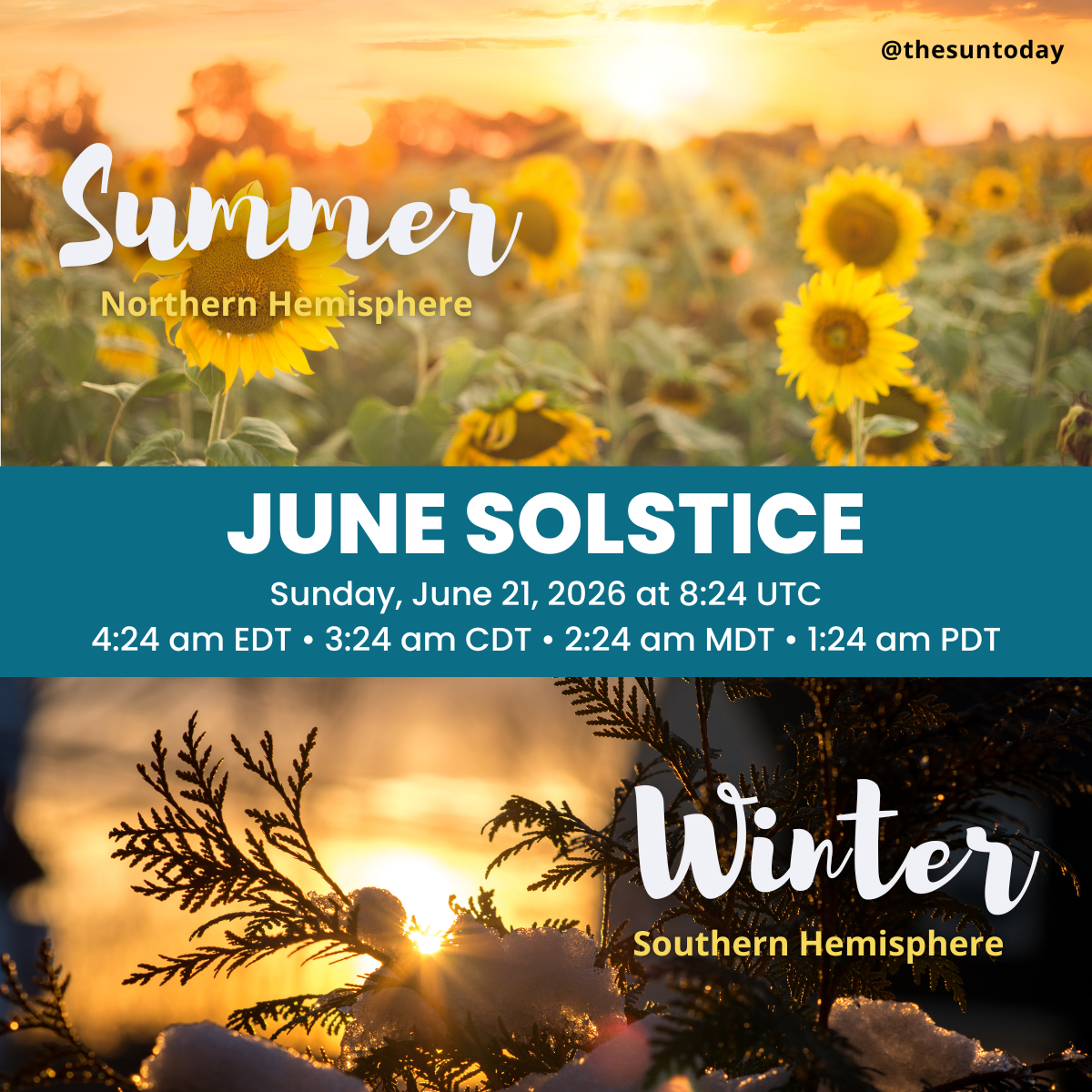
Mark your calendars: The June Solstice arrives on Sunday, June 21, 2026, at 08:24 UTC (4:24 am EDT | 1:24 am PDT). 🌞🌎 ☀️🏖🌻🍉🌴🌺🍦🛶🦋
Convert Your Timezone
Weird & Wonderful Things
About the June 2026 Solstice
- 🌅 Sun “stands still”: Solstice comes from sol (Sun) + sistere (to stand still) – the Sun’s path seems to pause for a few days at its northernmost point before shifting direction. MORE »
- 🔄 24-hour daylight & darkness: In the deep north, the Sun never sets (Midnight Sun); near the South Pole, it never rises (polar night). One Pole enjoys 24-hour sun, while the other sits in 24-hour darkness. MORE »
- 🌞 Not the latest sunset: Oddly, the earliest sunrise occurs before the solstice, and the latest sunset comes after. Earth’s tilt and orbit make solar noon “shift,” so the longest day is not perfectly aligned with those extremes.
- 🧭 Farther from the Sun: Summer doesn’t mean we’re closer to the Sun – it’s the opposite! Earth reaches aphelion (its farthest point from the Sun) in early July, just two weeks after the solstice. Our warm northern summer happens even as we’re farther from the Sun, because tilt, not distance, causes seasons. MORE »
- 🔭 Bonus sky show in 2026: A brilliant Venus–Jupiter conjunction lights up the evening sky on June 8–9, the Moon occults (covers) Venus in daylight on June 17, and the solstice itself falls just days after the June 14 new Moon – giving skywatchers exceptionally dark, planet-rich evenings.
- 🌌 High noon, low noon: At midday on June 21, the Northern Hemisphere’s Sun is at its highest of the year, climbing nearly overhead in the tropics and casting the shortest shadows of the year. Meanwhile, Southern Hemisphere observers see their lowest noonday Sun, hugging the northern horizon.
The solstice isn’t just a day on the calendar — it’s a
turning point in Earth’s orbit with quirks you won’t hear in most explainers.
This is the moment when one half of Earth has its longest day and the other its longest night…sort of.
The word solstice literally means the Sun appears to stand still, pausing in its north-south journey. Twice a year (June & December), the Sun’s direct rays reach their farthest point from the equator. This marks the change of seasons:
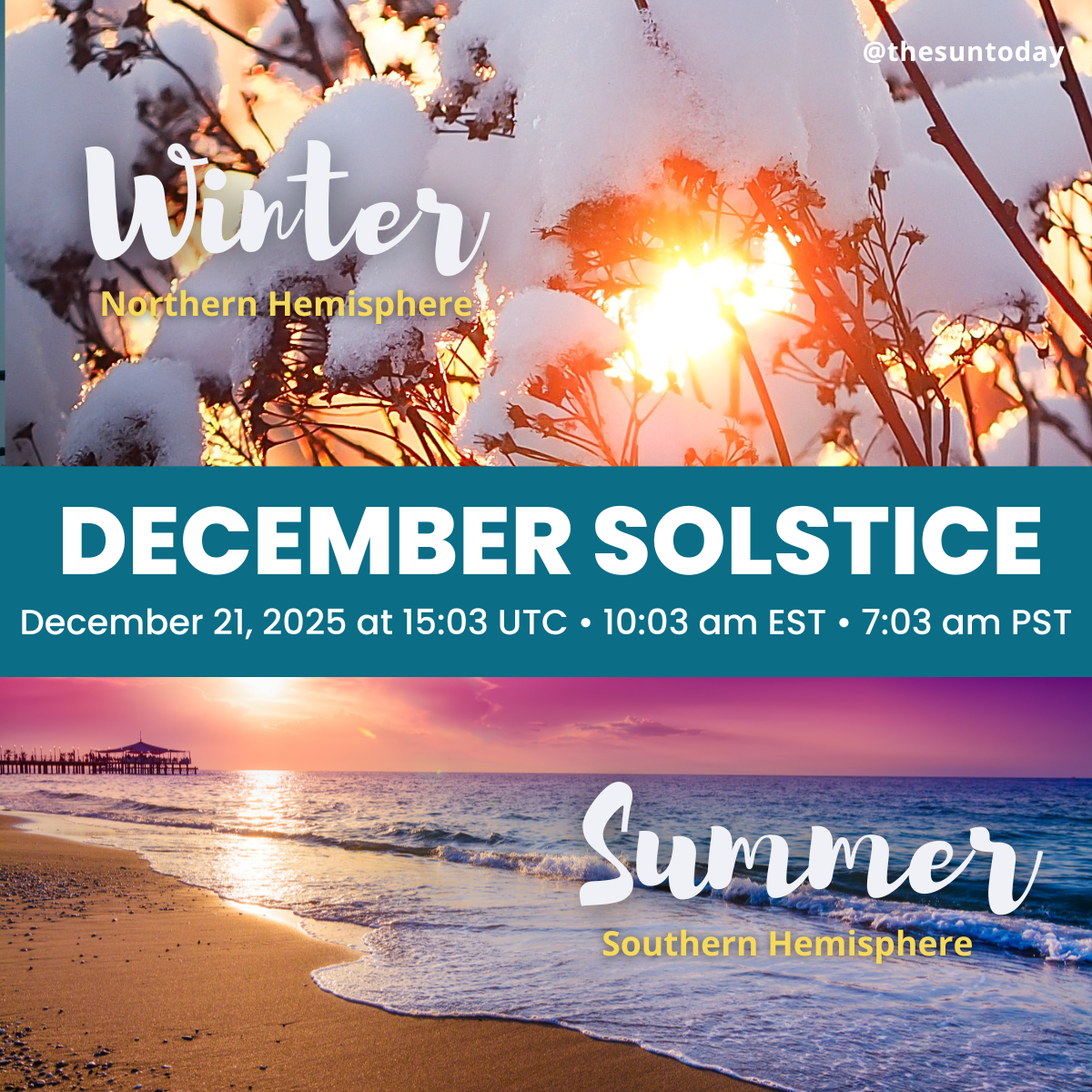
- Summer starts in the Northern Hemisphere (the longest day, the shortest night).
- Winter starts in the Southern Hemisphere (the shortest day, the longest night).
On the June Solstice, the Sun is positioned directly above the Tropic of Cancer (latitude ~23.5° North) at local noon. This is the northernmost point the Sun ever gets. Around this date, the Northern Hemisphere experiences its brightest days, while the Southern Hemisphere settles into midwinter. The difference is extreme: near the equator, day and night remain roughly 12 hours each, but closer to the poles, day length swings wildly – from 24-hour daylight to 24-hour darkness.
The Poles are especially strange…keep reading to learn why!
(Note: Meteorologists define seasons differently – “summer” and “winter” by temperature, starting June 1 – but astronomical seasons are tied to the Sun’s position. The next shift comes at the September equinox 2026, when autumn begins in the north and spring in the south.)
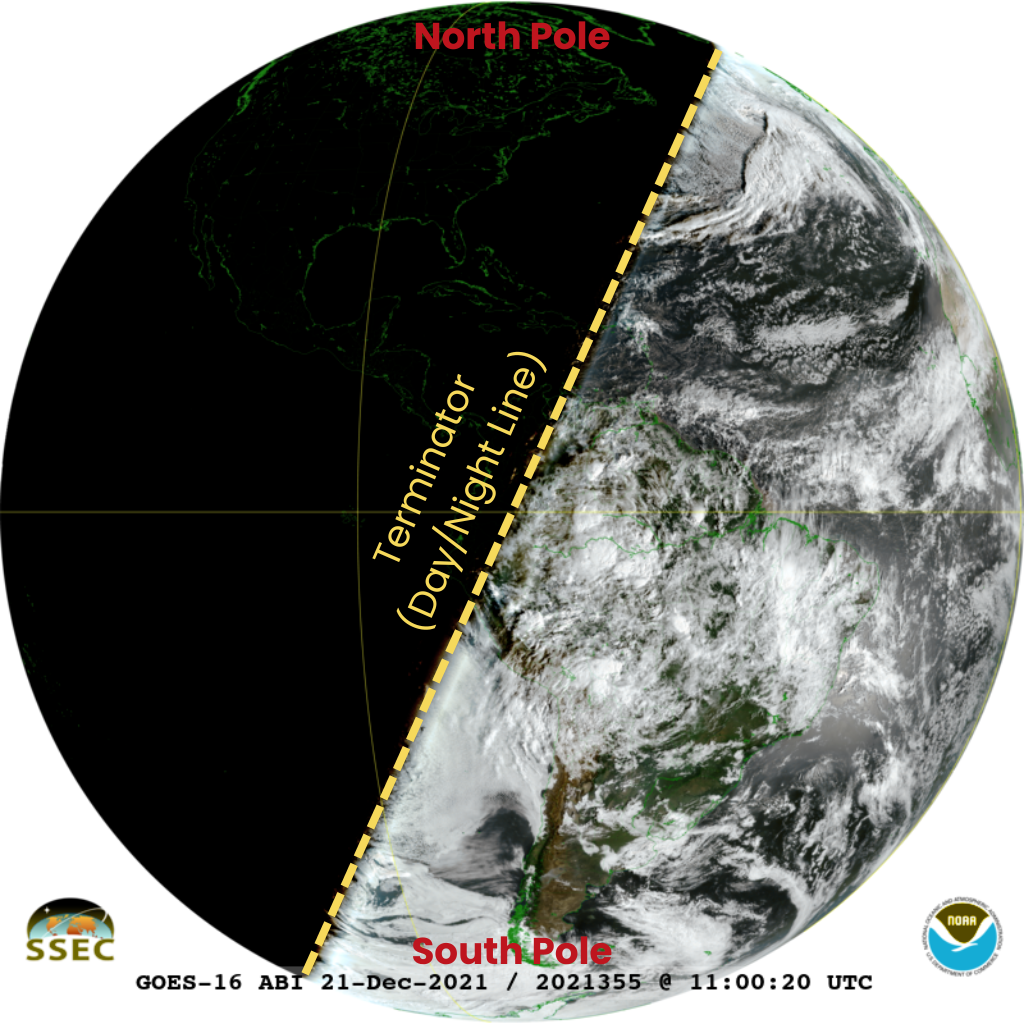
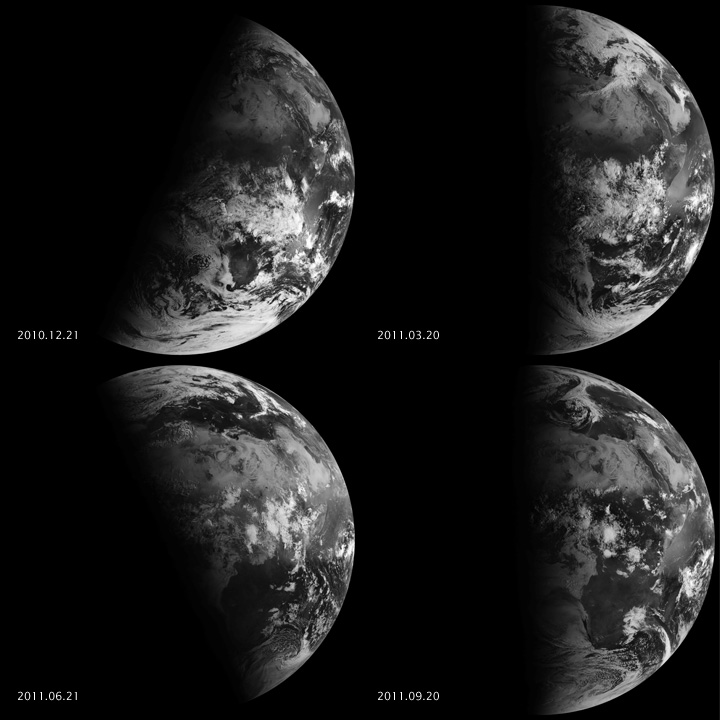
On the Solstice, the terminator line (the shadow boundary between day and night) is at its steepest tilt.
-
- Solstice = when Earth’s axis tilt toward/away from the Sun is maximized. The Northern Hemisphere tilts farthest toward the Sun (and the south tilts away from it).
- This creates an extreme distribution of sunlight: the North Pole is in 24-hour daylight, while the South Pole has 24-hour darkness. Areas above ~66.5° N see no sunset, and regions below ~66.5° S see no sunrise.
- The terminator (day/night line) is highly slanted with respect to Earth’s axis. From space at the solstice, one polar region lies entirely in day and the other entirely in night. (At the equinoxes, by contrast, the terminator runs straight through the poles.)
- From the Tropic of Cancer (23.5° N), the Sun is directly overhead at solar noon on this day. It’s the only time of year the Sun is exactly at zenith that far north.
- From the North Pole, the Sun circles the horizon all day, reaching about 23.5° above the horizon at “solar noon” (its highest for the year). From the South Pole, the Sun never rises – it’s roughly 23.5° below the horizon at local noon (the darkest it gets).
This extreme setup only occurs around the solstices. On any other day, the terminator is tilted to a lesser degree. Six months from now (December solstice), the situation will be exactly reversed – the South Pole will be sunlit and the north in darkness.
🌍 Fun Sun–Earth Geometry
The June solstice happens at the exact moment when the Sun’s center reaches its northernmost position in Earth’s sky – directly above the Tropic of Cancer (23.5°N). In terms of celestial geometry, the Sun’s path (the ecliptic) is angled about 23.5° away from the celestial equator (Earth’s equator projected into space).
- Earth’s axial tilt: Earth’s spin axis is tilted ~23.5° relative to its orbital plane. This tilt is why we have seasons.
- Subsolar point: the point on Earth where the Sun is directly overhead. It migrates north/south through the year. At the June solstice, it hits its northernmost latitude (23.5°N), and then begins moving southward.
- Celestial equator: Earth’s equator projected onto the sky. The Sun appears north of this line for half the year and south of it for the other half.
- Ecliptic: the Sun’s apparent path through the sky over a year (a reflection of Earth’s orbital plane). It is tilted 23.5° relative to the celestial equator.
- Equinoxes vs. Solstices: The equinoxes are the two points where the ecliptic and celestial equator intersect – in March and September. The solstices are the points where the Sun is farthest from those intersections – its peak north or south excursion.
In March and September, the Sun crosses the celestial equator (equinox = equal day/night). In June, it reaches its northernmost point (the Tropic of Cancer, ~23.5°N). In December, it reaches its furthest south (the Tropic of Capricorn, ~23.5°S). After each solstice, the Sun appears to “turn around” and head back toward the equator.
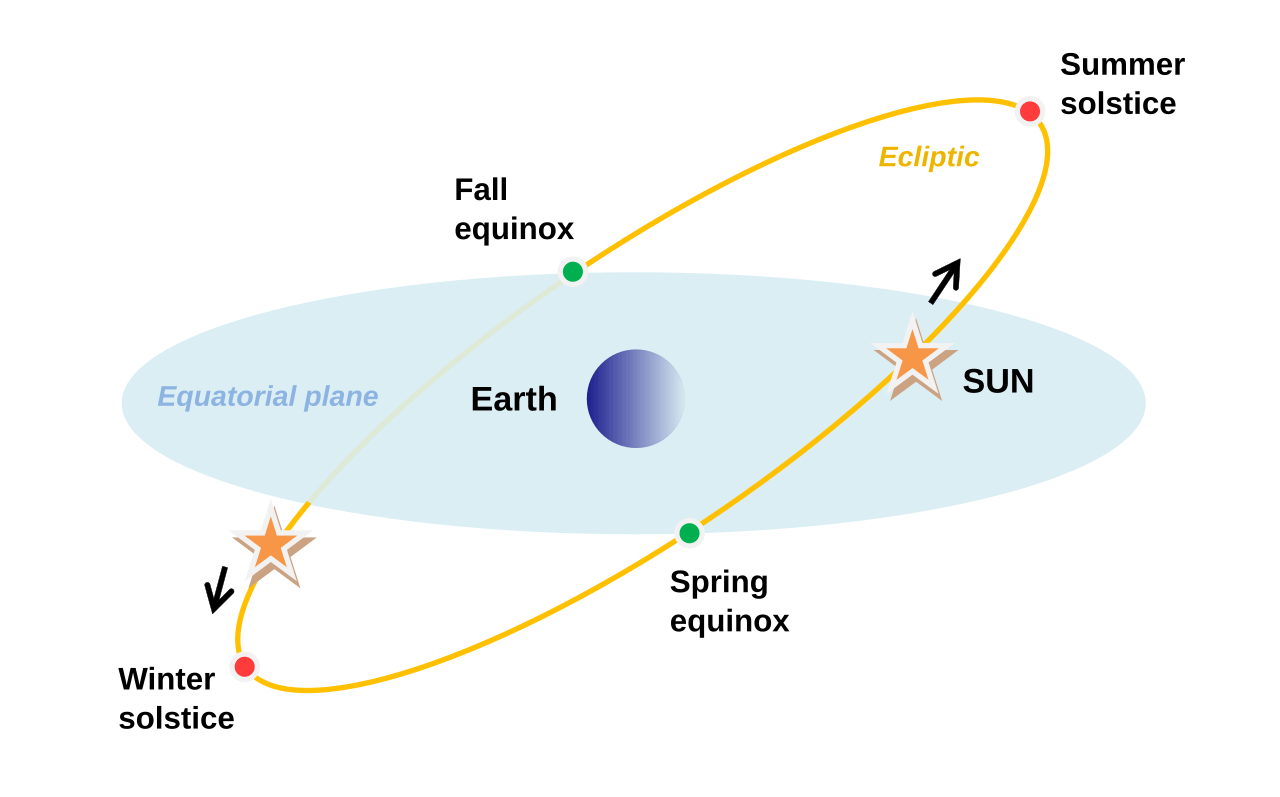
The celestial equator and the ecliptic are tilted relative to each other by 23.5° — that’s Earth’s axial tilt. These two imaginary planes (Earth’s equator projected into space and its orbital path around the Sun) intersect and diverge in meaningful ways that define the four key seasonal points of the year:
🌐 The Four Solar Milestones:
-
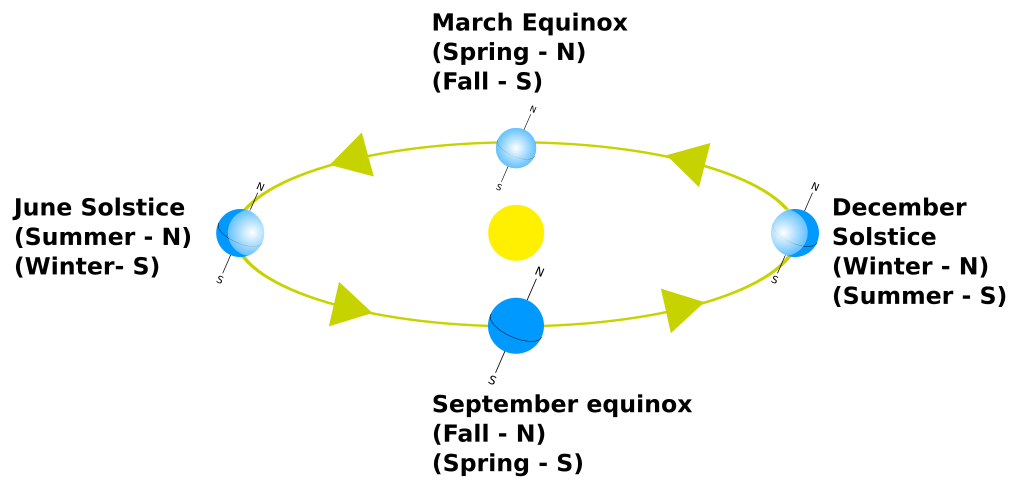
March Equinox → Northward crossing: The Sun crosses the celestial equator heading north
→ Marks the start of spring in the Northern Hemisphere and autumn in the Southern. -
June Solstice → The Sun reaches its northernmost point in the sky, directly above the Tropic of Cancer (23.5°N)
→ Marks the start of summer in the Northern Hemisphere and winter in the Southern. -
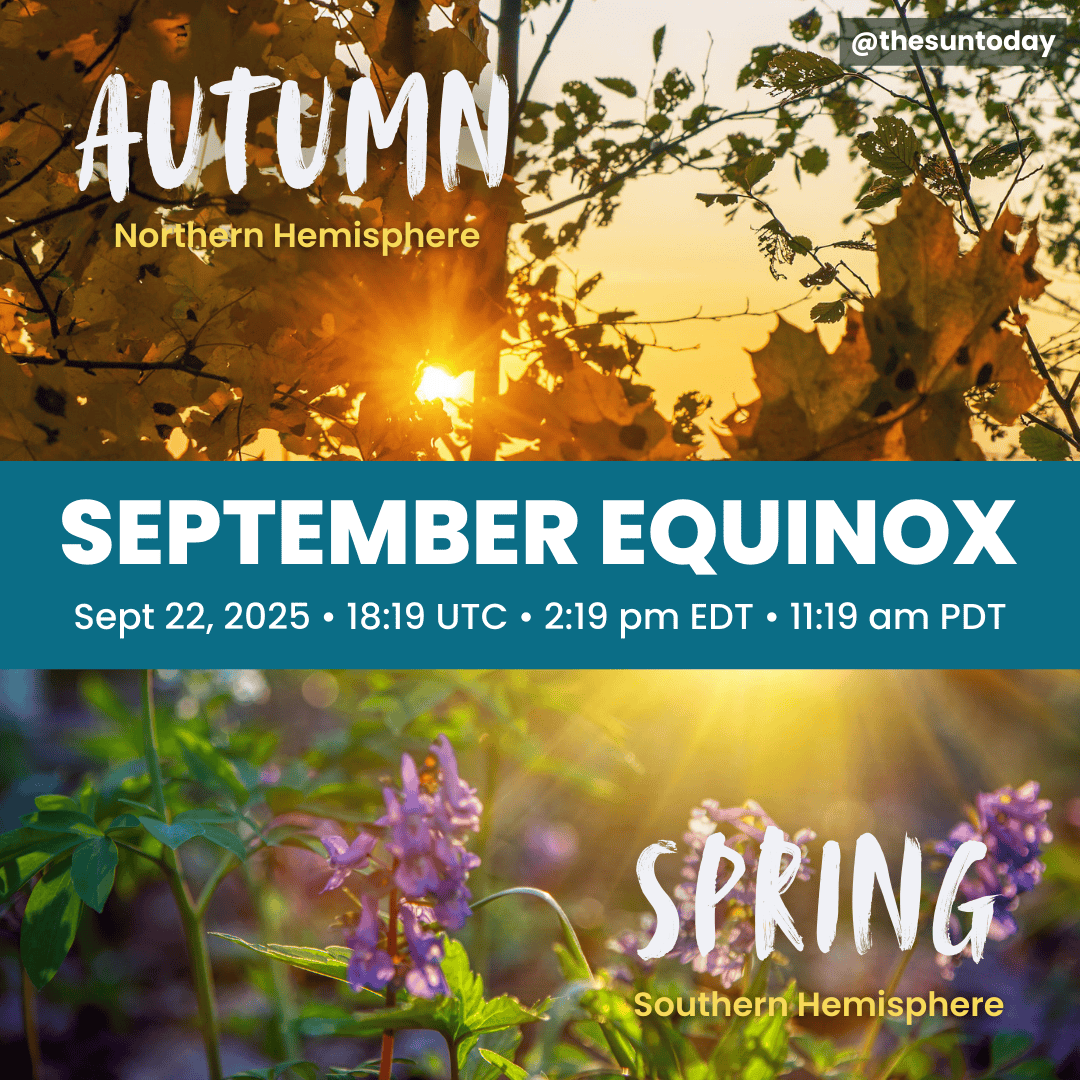
September Equinox → Southward crossing: The Sun crosses the celestial equator heading south
→ Marks the start of autumn in the Northern Hemisphere and spring in the Southern. -
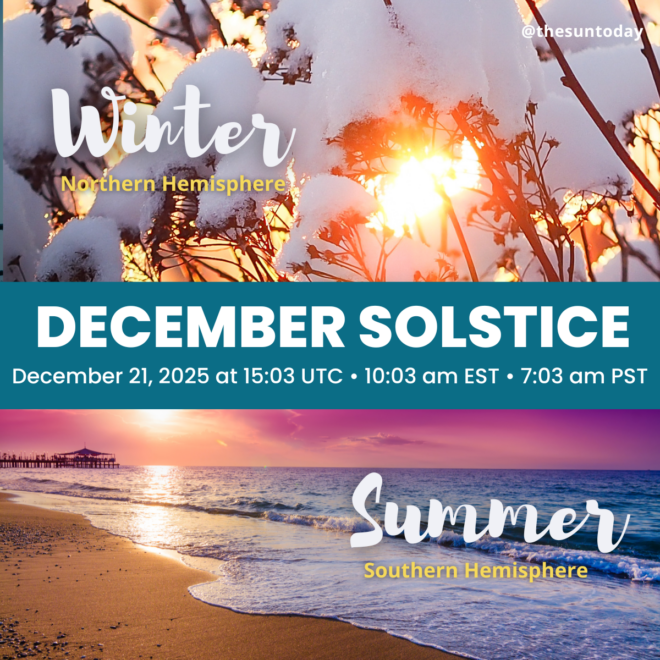
December Solstice → The Sun reaches its southernmost point in the sky, directly above the Tropic of Capricorn (23.5°S)
→ Marks the start of winter in the Northern Hemisphere and summer in the Southern.
These four points — two equinoxes (where the planes intersect) and two solstices (where the Sun is at maximum separation from the celestial equator) — define the rhythm of Earth’s seasons. The solstices represent the extreme edges of the Sun’s annual path, while the equinoxes are the balance points in between.
Solstice = Point + Event + Day
- Point → The position on the ecliptic where the Sun is at maximum declination (23.5°N in June, 23.5°S in December).
- Event → The moment the Sun’s center arrives at that point (in 2026, that moment is 08:24 UTC on June 21).
- Day → The date on our calendar that marks this event (commonly called the solstice).
We use the center of the Sun for the precise definition of the solstice moment. The Sun isn’t a point – it’s a disk about 0.5° wide. Its upper edge appears above the horizon a few minutes before the center, and its lower edge disappears a few minutes after the center sets. By using the Sun’s center, everyone on Earth can agree on the exact time of the solstice event.
(Fun fact: the June solstice can fall on Dec— err, on June 20, 21, or 22 depending on the year, due to leap years and the fact that Earth’s orbit isn’t a neat 365 days. A June 22 solstice is rare – the last was in 1975, and the next won’t come until 2203! In 2026, it’s on the 21st in UTC.)
☀️ Viewing the Sky from Earth at the June Solstice 👀
The one rule that always holds true: everything rises in the east and sets in the west (except near the poles, where directions get… weird). This happens because Earth spins eastward. But how things move through your sky — especially the Sun’s arc — depends on your location and the time of year.
The June solstice brings very different Sun paths to each hemisphere.
👉 Face the equator. Then look up.
This is the simplest way to understand where the Sun goes:
-
In the Northern Hemisphere, face south (toward the equator).
The Sun takes a high, long arc across the southern sky — it climbs steeply, and shadows are short all day. In the tropics, it may pass nearly overhead. -
In the Southern Hemisphere, face north (also toward the equator).
The Sun stays low, and its arc is short and shallow. Days are at their shortest, and even at noon the Sun hugs the northern horizon.
👉 At the Equator? Look up and slightly north.
You’re in a sweet spot. On the June solstice:
- The Sun rises just north of due east, climbs to about 66.5° altitude at noon, and sets just north of due west.
- Shadows point south all day.
- After the solstice, the Sun will begin shifting back southward, on its journey toward the September equinox.
🌐 Bonus tip: If you’re tracking the Sun’s position across the seasons, the June solstice marks the northernmost point in its yearly swing. It’s the highest noonday Sun of the year in the north, and the lowest in the south.
🌙 What About the Moon?
The Moon’s path closely follows the ecliptic — the same tilted plane that defines the Sun’s apparent journey across our sky. That means:
- In the Northern Hemisphere, the Moon travels mostly through the southern sky.
- In the Southern Hemisphere, it sweeps across the northern sky.
- Near the Equator, it alternates north and south, depending on the lunar phase and month.
During the June solstice season, this effect becomes extra dramatic — but in reverse from December:
- Around full Moon, the Moon rises opposite the Sun — so when the Sun is high in the north, the full Moon stays low in the south (and vice versa).
- For observers in the Northern Hemisphere, the June full Moon takes a very low path across the sky — the lowest of the year. (That’s exactly why the June “Strawberry Moon” often looks big, golden, and dramatic near the horizon!)
- For those in the Southern Hemisphere, it’s the highest full Moon of the year.
That’s because the full Moon in June lies near the ecliptic’s southernmost point — opposite the Sun’s northernmost spot at solstice.
🌌 What About the Planets?
- Mercury and Venus — the inner planets — are always near the Sun in the sky. So when the Sun is high and north, they tend to appear in the evening or morning twilight near the horizon, following the Sun’s path.
- Outer planets — like Mars, Jupiter, and Saturn — also follow the ecliptic. Depending on the year, they appear north or south of the celestial equator, shifting with the seasons.
🌟 In June 2026:
- Venus blazes in the western sky after sunset — the brilliant “evening star.”
- Jupiter shines near Venus early in the month before sinking into twilight.
- Mercury makes its best evening appearance of the year low in the west.
- Saturn and reddish Mars climb the pre-dawn eastern sky for early risers.
- And bonus: Venus and Jupiter have a gorgeous close conjunction on June 8–9!
👉 No matter where you live, you can see all the bright planets — but whether you look north or south depends on your latitude and the time of year.
📅 For the June 2026 Solstice, The Sun…
- Is highest in the sky at the North Pole
- Is overhead at solar noon at the Tropic of Cancer (~23.5° N)
- Is lowest (or absent) at the South Pole
To describe where the Sun is, we use Azimuth = compass direction (0° = north, 90° = east, 180° = south, 270° = west), and Altitude = angle above the horizon.
☀️ At the North Pole
The Sun reaches its highest point in the sky all year: ~23.5° above the horizon.
- It has been continuously above the horizon since rising around the March Equinox.
- From late March to late June, the Sun spirals higher each day.
- On June 21, 2026, it reaches solar noon — the peak of its 6-month arc.
- After this date, it begins spiraling downward each 24-hour loop.
- The next sunset at the North Pole will be at the September 2026 equinox.
- 🌞 It traces a full circle around the horizon each day, never setting.
- Sunrise & sunset times at the North Pole
☀️ At the Tropic of Cancer (~23.5° N)
This is the only day the Sun is directly overhead at noon here.
- On June 21, the subsolar point is exactly at this latitude.
- The Sun rises nearly straight up from the northeast (~60° azimuth) and sets in the northwest (~300° azimuth).
- At solar noon, the Sun reaches 90° altitude — straight overhead.
- After the solstice, the subsolar point begins drifting southward again.
- Places just north or south of the tropic will see a small but noticeable change in Sun height over the next weeks.
🌍 At the Equator (0° latitude)
Not quite “equal” day and night, but still close!
- The Sun does not reach overhead at noon — it peaks around 66.5° altitude, since it’s far north of the equator.
- The Sun rises north of due east (~67° azimuth) and sets north of due west (~293° azimuth).
- Shadows point southward all day long (in contrast to equinoxes, when they vanish at noon).
- Day length is still ~12 hours, but slightly more than night due to atmospheric refraction.
- After the solstice, the Sun starts shifting back southward toward the equator.
- Sunrise & sunset times in Quito, Ecuador
🌌 At the South Pole
The Sun is completely below the horizon, about 23.5° beneath it at “solar noon.”
- The Pole is in polar night — it hasn’t seen sunlight since the March equinox.
- Around the solstice, the sky is at its darkest of the year.
- However, it’s not pitch black all day: there’s a band of civil twilight (or nautical twilight) around noon depending on how far below the horizon the Sun is.
- The Sun will begin to slowly rise again after the solstice, culminating in sunrise at the September 2026 equinox.
- Sunrise & sunset times at the South Pole
🌞 The Longest “High Noon” on Earth 🌞
While equinoxes feature the longest sunrises and sunsets (because the Sun is skimming sideways along the horizon), the solstices bring something different — especially at the Poles:
- Instead of a slow rising or setting Sun, you get a Sun that circles the horizon, rising neither higher nor lower for days.
- The June solstice is the “peak noon” at the North Pole, the day the Sun reaches its maximum altitude of about 23.5° above the horizon.
- But here’s the catch: it barely moves vertically, and loops horizontally for weeks. The Sun’s apparent position at the Pole is so stable that for several days it appears to “pause” at that altitude — the origin of the word solstice (“Sun stands still”).
🌀 What’s Going On at the North Pole?
- The Sun rises at the March equinox, then spirals slowly higher each day.
- By June 21, it reaches its maximum height — ~23.5° above the horizon — at solar noon.
- Over the next days, it doesn’t change much. For nearly a week, the Sun loops around at about the same altitude, seeming to “stand still.”
- Afterward, it begins spiraling downward toward sunset at the September equinox.
This slow change is due to the tilted geometry of Earth’s axis. At the solstice, the Sun’s apparent path changes direction — not abruptly, but gradually — producing a lingering “high noon” effect, where for several days, the Sun appears stuck in place.
🌌 And at the South Pole?
- Total darkness. But not completely the same every day.
- Around the solstice, the Sun is at its deepest point below the horizon — about 23.5°.
- It stays at that low angle for several days.
- Just as with the North Pole’s Sun “pause” at its highest point, the South Pole’s solar depression angle also “pauses.”
- There’s a gradual change: the twilight gets fractionally brighter each day after the solstice — the hint that the Sun is preparing to return.
❄️ So, No Multi-Day Sunrise or Sunset?
Not at solstice. Unlike equinoxes — when the Sun is skimming across the horizon, causing drawn-out transitions — the solstice is a moment of solar reversal:
- At the equinox, the Sun is rising or setting at the poles, producing the longest transitions (about 4+ days).
- At the solstice, the Sun is at maximum or minimum elevation, and not crossing the horizon.
- So there’s no sunrise or sunset — just a pause in the Sun’s path.
But the similar concept is the “pause” itself:
- Equinox → Long transition across the horizon
- Solstice → Long pause at the extreme point (peak height or deepest night)
🌟 Summary
| Effect | Equinox | Solstice |
|---|---|---|
| Sunrise/Sunset at Poles | Yes – stretched over ~4 days | No – Sun is either fully up or fully down |
| Daylight at Both Poles | Brief overlap due to Sun’s size + refraction | No – one Pole is 24h day, the other 24h night |
| Sun’s Altitude Change | Rapid – crossing horizon | Minimal – “stands still” at extreme |
| Unique Feature | Longest sunrise/sunset | Longest “pause” in solar height |
🌍 Other Places on Earth at the June Solstice
At the Poles, you get the full spectacle — a Sun that either circles endlessly above the horizon (North Pole) or never rises (South Pole).
Everywhere else, you only see part of the Sun’s looping path — the daily arc it traces across your local sky. During the solstice, that arc is either at its highest (in the Northern Hemisphere) or lowest (in the Southern Hemisphere) for the year.
- In the Northern Hemisphere, the Sun follows a high, soaring arc across the sky. Days are long, and at solar noon the Sun climbs higher than at any other time of year.
- In the Southern Hemisphere, the Sun’s path is low and short, and midday brings weak, slanting winter light — the shortest day of the year.
The direction of sunrise and sunset shifts, too:
At most times of year, the Sun doesn’t rise exactly due east or set exactly due west. Instead, its rising and setting points drift north or south depending on the season.
- On the June solstice, the Sun rises farthest northeast and sets farthest northwest for observers in both hemispheres.
- This is the most extreme offset of the year — it’s the northernmost sunrise/sunset azimuth.
Here’s how it plays out:
- The farther north you are (toward the Tropic of Cancer and beyond), the higher the Sun’s arc — and the longer the day, until you reach the Arctic Circle and the Sun never sets at all.
- The farther south you are, the lower the Sun climbs and the shorter the day — until, below the Antarctic Circle, the Sun never rises.
☀️ Want to see how your location compares?
Check out TimeandDate.com for local sunrise, sunset, and Sun path data. You can see how the Sun’s daily arc shifts with the seasons — and how the solstice brings its most dramatic swing of the year.
👉 Fun fact: Day and night aren’t exactly equal on the equinox because of Earth’s atmosphere bending sunlight (refraction) and the size of the Sun’s disk. But they’re pretty close!
🌍 Daylight Change Around the June Solstice
📍 Click on the location name for the exact timing!
| Location | Latitude | Solstice Day Length | Change per Day (after solstice) | Seasonal Swing | Notes |
|---|---|---|---|---|---|
| NORTH POLE | 90°N | 24 hours (Midnight Sun) | Losing light slowly | 24h daylight (June) → 24h night (Dec) | Sun circles the sky at its highest (~23.5°). Begins descending after June 21. Won’t set until the September equinox. |
| Utqiaġvik (Barrow), Alaska | 71°N | 24 hours | ~Losing light slowly | 24h daylight (June) → 24h night (Dec) | In the midst of Midnight Sun. The Sun won’t set until early August. Bright around the clock. |
| Fairbanks, Alaska | 65°N | ~21h 50m | ~4 min lost/day | ~21h (June) → ~3½h (Dec) | Nearly endless daylight; only a brief twilight “night.” Dramatic darkening comes in fall. |
| , | 41°N | ~15h 6m | ~1 min lost/day | ~15h (June) → ~9h (Dec) | Longest day of the year. Latest sunset comes a few days after the solstice. |
| Miami, USA | 26°N | ~13h 45m | ~40 sec lost/day | ~13½h (June) → ~10½h (Dec) | Mild seasonal change. Sunrise and sunset times begin drifting after solstice. |
| Quito, Ecuador | ~0° | ~12h 07m | < 1 sec/day | ~12h year-round | Day length nearly constant. Sun always rises & sets near same time. |
| SOUTH POLE | 90°S | 0 hours | Gaining light slowly | 24h night (June) → 24h daylight (Dec) | Deepest polar night (Sun ~23.5° below horizon). Twilight returns gradually. Sun rises at the September equinox. |
☀️ How Much Sunlight Do the Seasons Bring?
- Poles → “All in”: months of uninterrupted day or night
- High latitudes → Rapid light change, extreme seasonal contrast
- Mid-latitudes → Noticeable shifts in sunrise/sunset and day length
- Tropics & Equator → Little seasonal change, days hover around 12 hours year-round
🌟 5 Seasonal Sky Facts
1. The June Solstice is the start of a new season
It marks Day 1 of astronomical summer in the Northern Hemisphere and astronomical winter in the Southern Hemisphere. Cultures worldwide recognize this turning point of the Sun – for thousands of years, the summer solstice has been celebrated as the height of the Sun’s power, from Midsummer bonfires in Scandinavia to the dawn gathering at Stonehenge.
2. Earth is near its farthest from the Sun
Surprise – Earth is only about two weeks from aphelion, its farthest point from the Sun (happening in early July 2026). That’s right: the Northern Hemisphere’s warm summer occurs when we’re actually farther from our star. It’s a powerful reminder that Earth’s tilt – not distance – causes the seasons.
3. The earliest sunrise and latest sunset don’t happen on the solstice
If you’re looking for the very earliest sunrise or latest sunset of the year, they occur a week or two around the solstice, not on that exact date. This is due to the slight wobble in solar time caused by Earth’s tilt and elliptical orbit (the “Equation of Time”). For mid-northern latitudes, the earliest sunrises occur in early-to-mid June, while the latest sunsets come in late June or early July. (In the Southern Hemisphere, the timing is similarly offset around the December solstice.)
4. Astronomical vs. Meteorological summer
Astronomers define summer by the solstice-to-equinox cycle (June 21 to Sept 22, in the north). Meteorologists, however, define summer as June 1 through Aug 31 for simplicity and record-keeping. So if you hear “first day of summer,” it could mean different things – the scientific (astronomical) start at solstice, or the start of the warmest months on the calendar.
5. It’s a global moment
No matter where you live, the solstice is happening for everyone at the same instant – connecting the whole planet in one celestial event. Of course, its effects differ: while northerners hit the beach, southerners light winter fires. But it’s two sides of the same coin. The Sun’s energy that is high and abundant up north is low and fleeting down south. The solstice reminds us that Earth is a tilted sphere sharing one big orbit – one hemisphere’s day is the other’s night.
A cultural celebration for 1000s of years!
Solstices have been revered as an essential part of many cultures for thousands of years. Thousands gather each year to watch the Sunrise at Stonehenge in England — stones that have stood for over 5,000 years, aligned to the solstice Sun. They were not the only structures built with a connection to the solstices. In 2026, the June solstice falls on a Sunday morning (UTC), which tends to draw especially large weekend crowds to the Stonehenge dawn gathering. EarthSky has put together an excellent article on what a solstice is and its connection to people across our planet, past and present. 2026 June solstice: All you need to know »
Watch the first Summer sunrise at Stonehenge
For some solstice excitement — or at least a little connection to how ancient people focused on the Sun — tune into the live feed from Stonehenge for the solstice sunrise.
🌟 Sky Highlights Around the Solstice
Venus–Jupiter Conjunction — June 8–9, 2026
The two brightest planets in our sky, Venus and Jupiter, put on a spectacular show in early June. On the evenings of June 8 and 9, they snuggle up just over a degree apart in the western sky after sunset, near the “twin” stars Castor and Pollux in Gemini. Venus shines at a dazzling magnitude –4.0 and Jupiter at –1.9, making them impossible to miss as twilight fades. Look west about 30–45 minutes after sunset. If you have binoculars, you might even glimpse some of Jupiter’s moons. This brilliant “meet-up” of the sky’s queen and king planets is a perfect prelude to the solstice.
The Moon Occults Venus — June 17, 2026
Here’s a rare treat: on June 17, the slender crescent Moon will pass directly in front of (occult) brilliant Venus — and it happens in daylight across much of North America. With careful planning (and never pointing optics near the Sun), skywatchers can watch Venus wink out behind the Moon’s edge and reappear on the other side. Even without the occultation, the crescent Moon joins Venus, Jupiter, and fading Mercury for a beautiful evening grouping on June 16–17. It’s a stunning lineup as the solstice approaches.
A Dark-Sky Solstice & the Low Strawberry Moon
The solstice arrives just one week after the new Moon of June 14, so the longest days come with refreshingly dark, moonless evening skies — ideal for spotting the planet parade low in the west and the summer Milky Way later at night. Then, on June 29, the full “Strawberry Moon” rises — and because it falls so close to the solstice, it traces the lowest path of any full Moon all year for Northern Hemisphere viewers. A low Moon near the horizon often glows golden, orange, or even reddish, making for gorgeous photos at moonrise. (Southern Hemisphere viewers get the opposite: their highest full Moon of the year.)
🌸🍁 Season’s Greetings from the Sun
The June solstice reminds us that our tilted Earth dances with the Sun to create seasons: bright summer warmth and long days in the north, and deep winter, cold, long nights in the south. Cultures worldwide gather to mark this special turning point – celebrating the zenith of the Sun’s power or the promise of returning light. Wherever you are, take a moment to appreciate the unique sky of your season. The Sun has begun its slow turn – northern days will start getting shorter, while southern days will get longer. The cycle continues, connecting us all under one Sun.
CREDITS: , EarthSky, The Planetary Society, TimeandDate.com, and owners of videos that have been embedded – please click on them for full details.