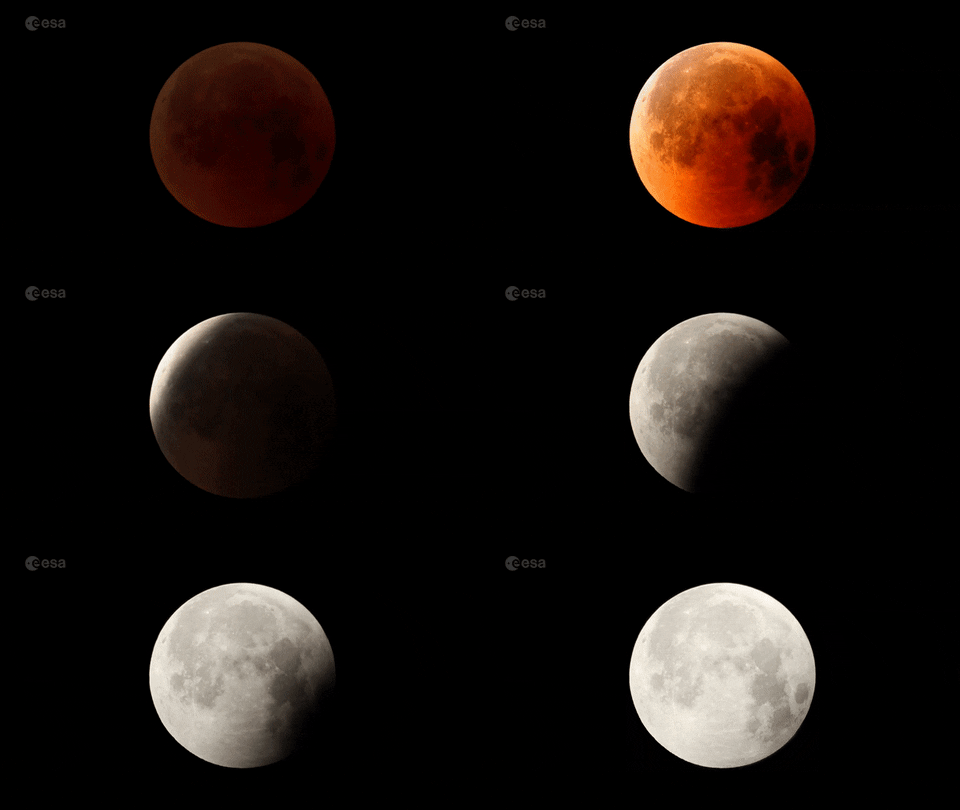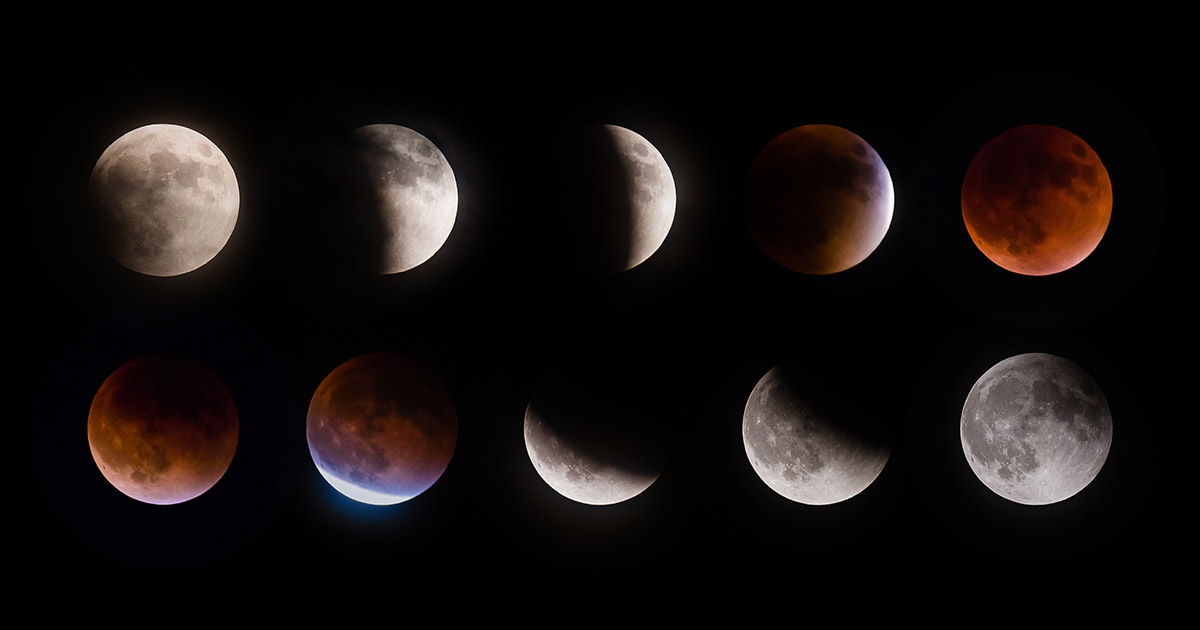
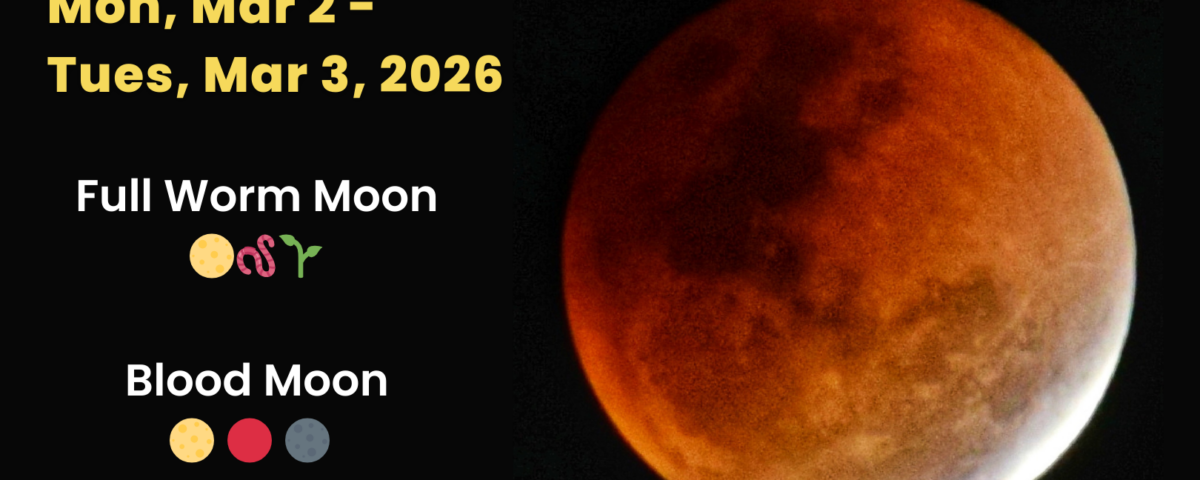
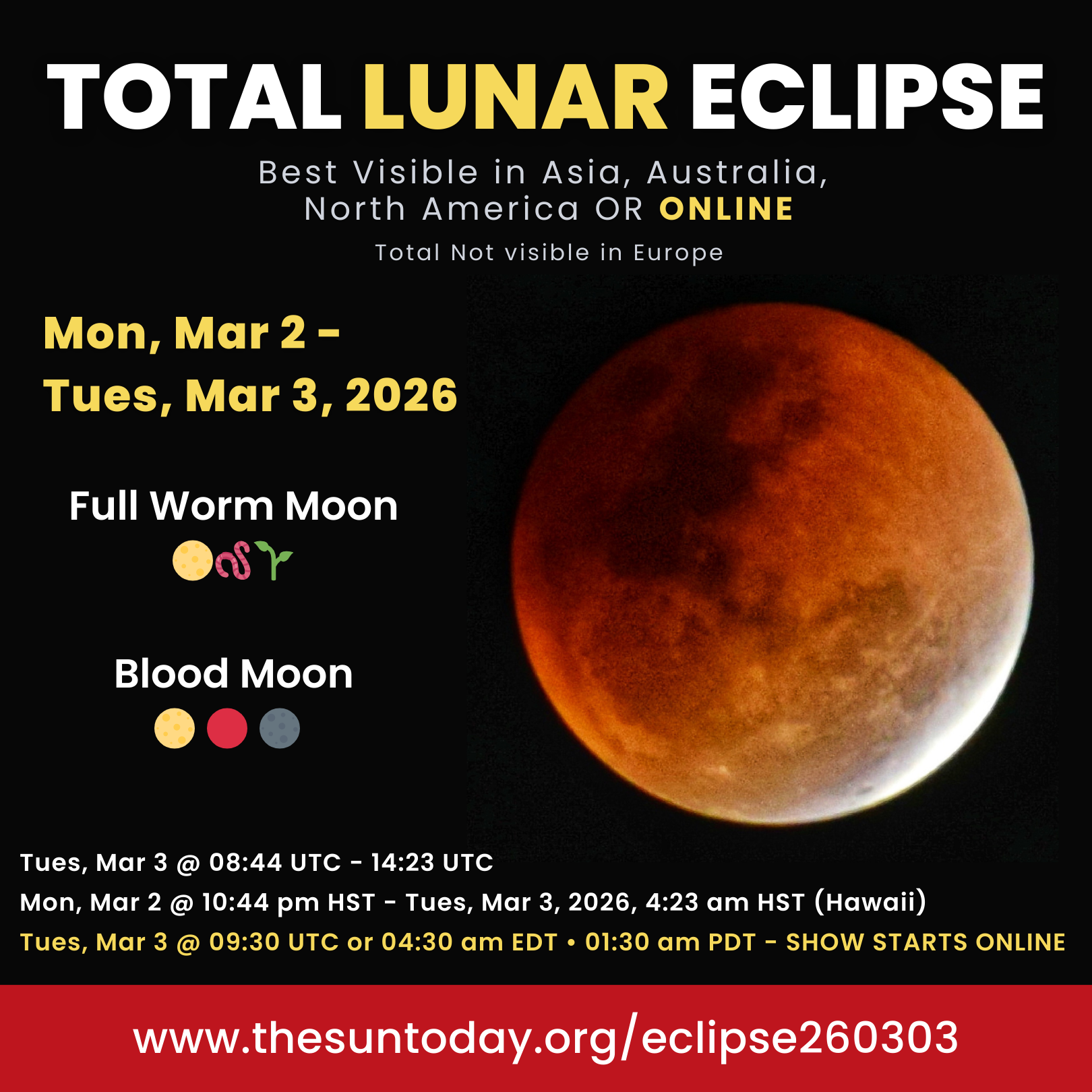
🌕✨ Total Lunar Eclipse Alert: March 3, 2026!
This is the LAST total lunar eclipse until late 2028 — don’t miss it!
🌟 Key Features of the Eclipse:
- Date: Tuesday, March 3, 2026
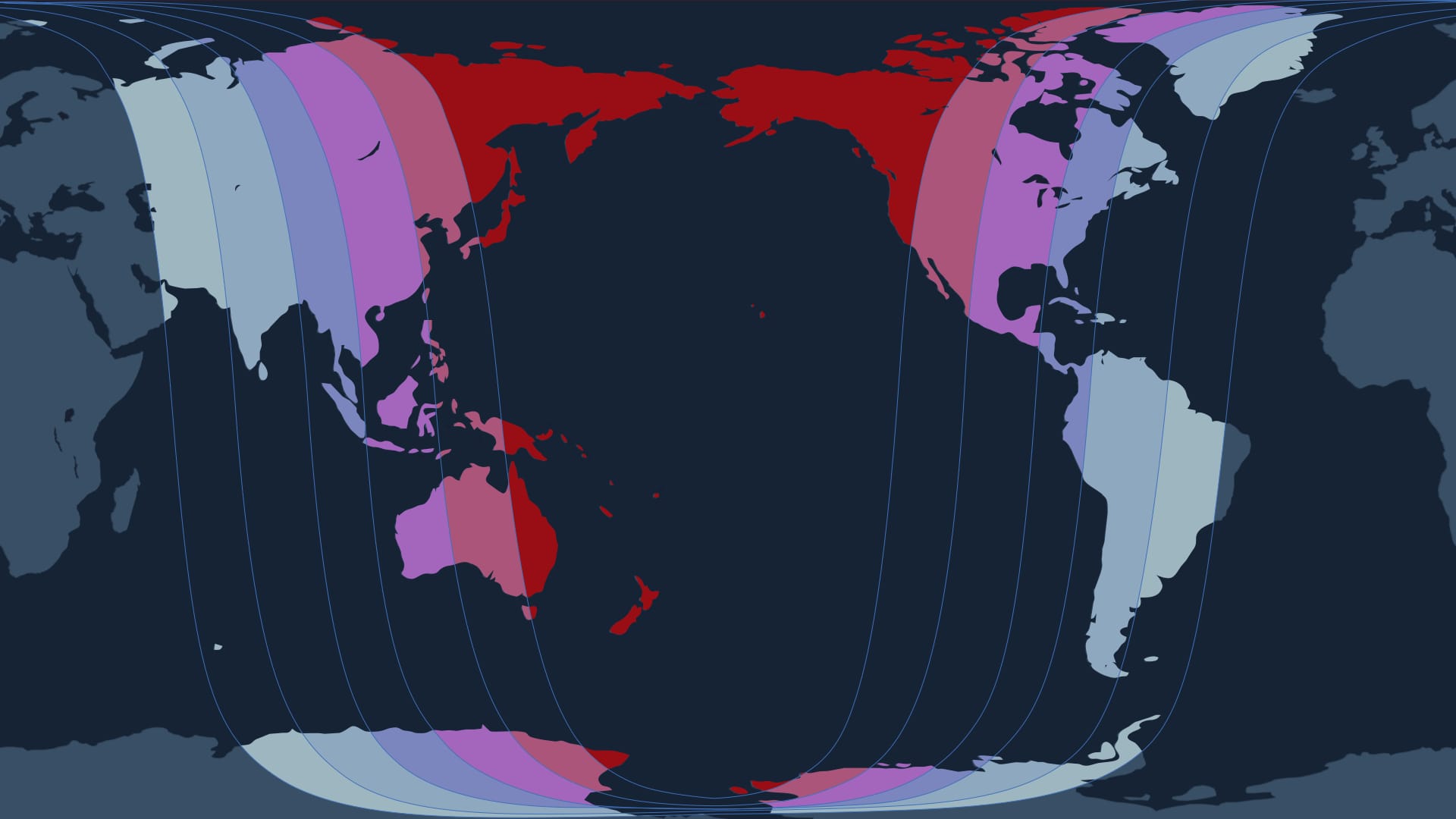
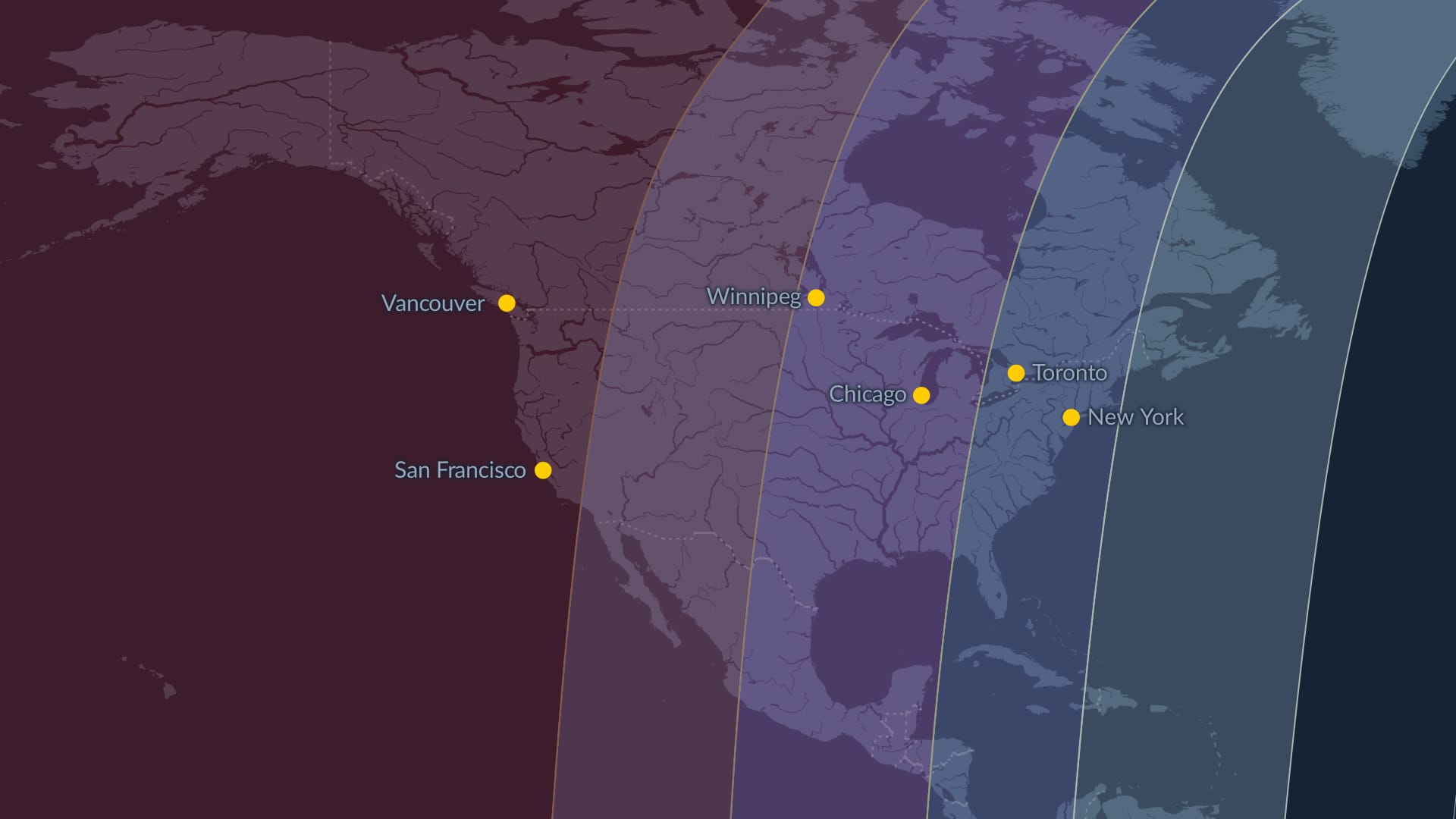
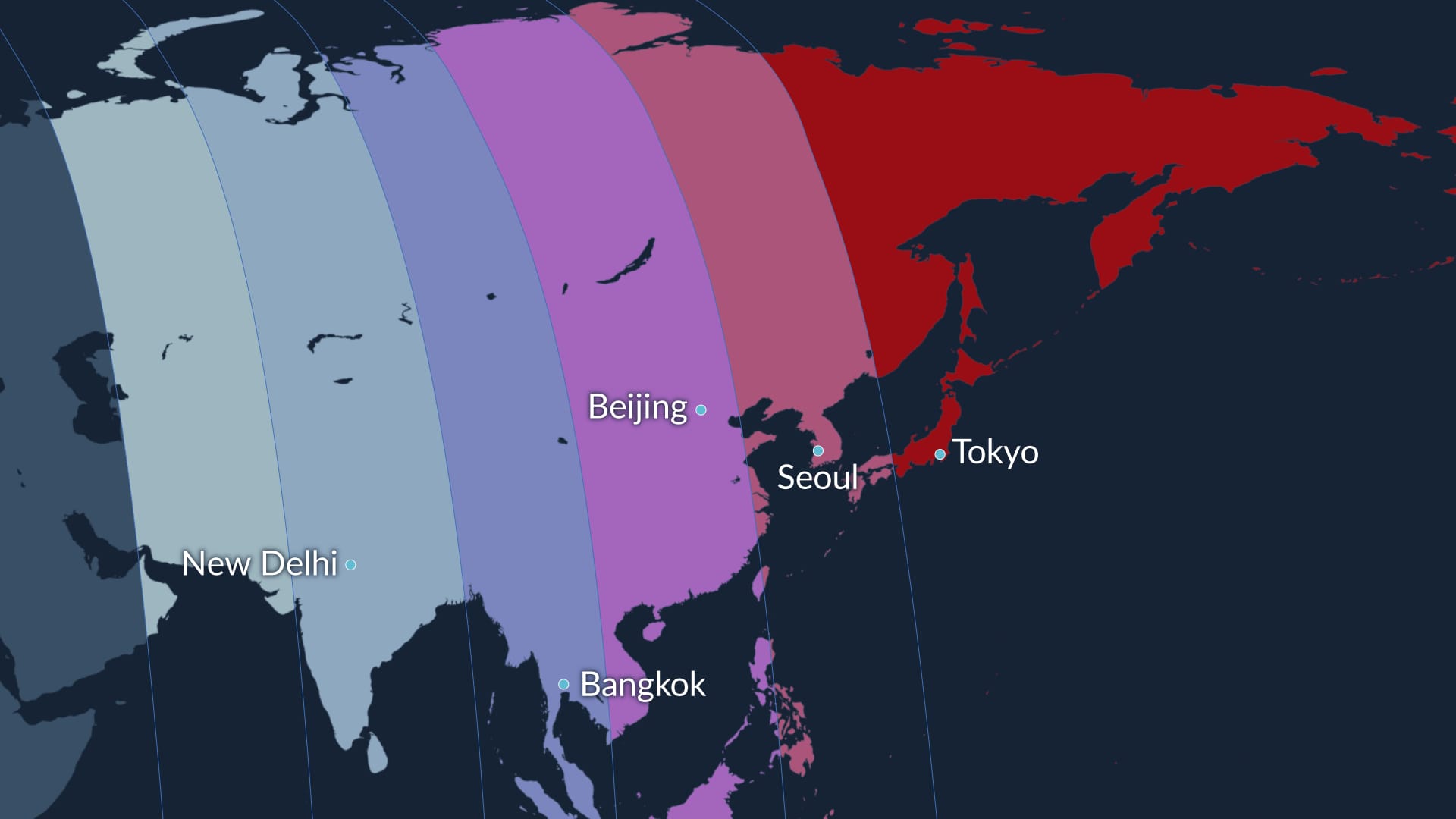
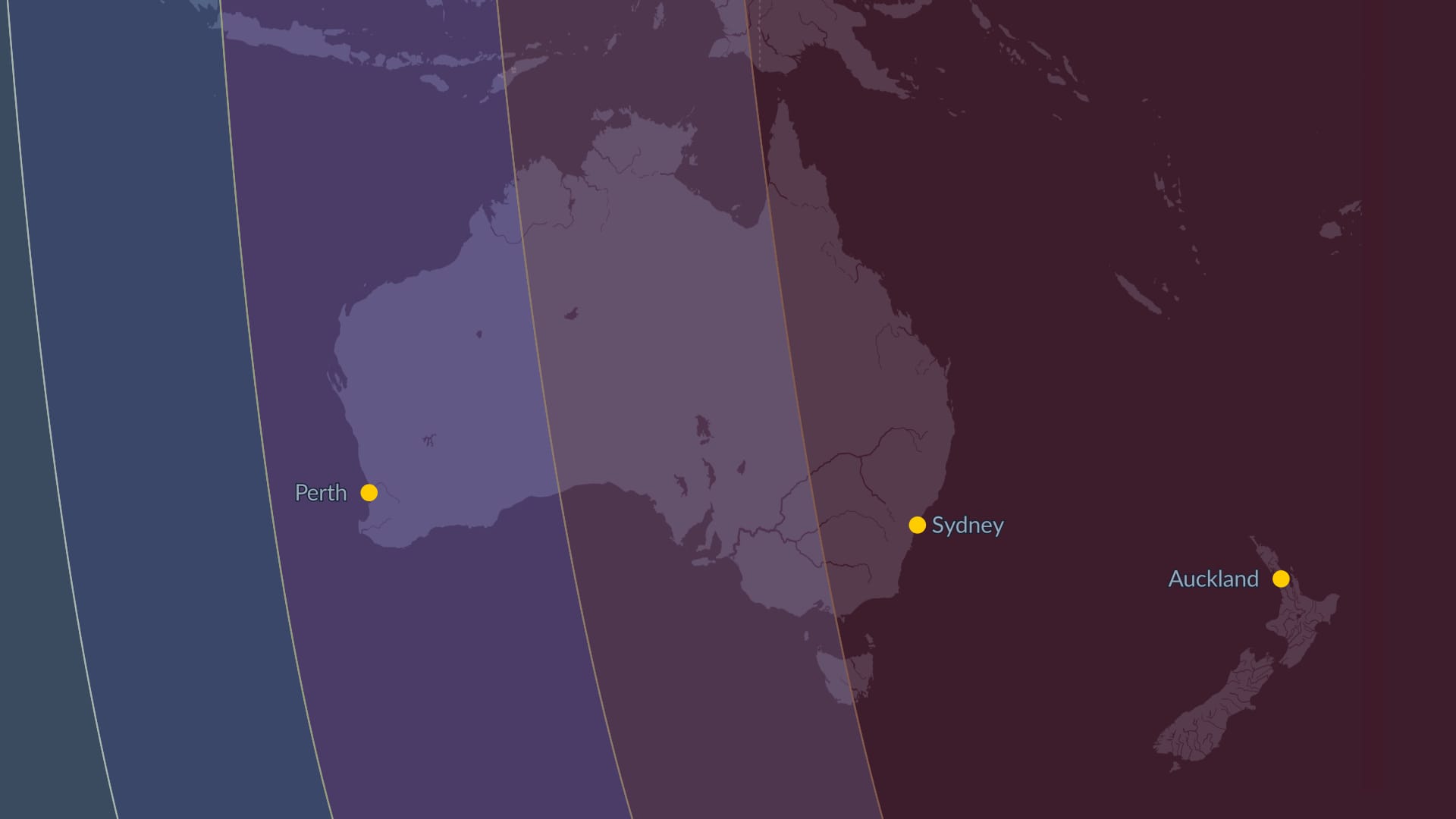
- Visible to: Pacific Rim — , Korea, eastern , Alaska, western US & , Hawaii, , New Zealand 🌏🌎
- Color: The Moon will turn a stunning deep reddish copper! 🌑❤️
- Totality: Nearly 59 minutes of Blood Moon! 🔴
- Bonus: The Moon occults galaxy NGC 3423 during totality! 🔭🌌
A total lunar eclipse occurs when the Earth’s shadow completely covers the Moon. 🌍➡️🌕 That’s when the Moon turns red, glowing with a mystical “Blood Moon” hue. 😱 It’s one of the most beautiful sights in the night sky. This full moon is the Worm Moon — named for the earthworms that emerge as the ground thaws in early spring, signaling the return of warmer days. 🪱🌱
Watch the Event Live – Telescope Views & Commentary
Live Broadcast from timeanddate.com –
starting Tuesday, March 3: 08:00 UTC or 3:00 am EST • 12:00 am PST
🌑 When & Where to Watch In-Person
- Best views: , Korea, eastern , far-east , Alaska, western , the US Pacific states, Hawaii, Polynesia, Micronesia, & New Zealand
- Moonrise eclipse: and New Zealand will see the Moon rise while already in eclipse — a dramatic sight on the eastern horizon! 🌅🌑
- Early morning views: Eastern North America can catch the Moon setting during or shortly after totality in the pre-dawn hours
- Partial/penumbral views: Central and South America, , and central/south Asia
- Not visible: Western and Africa miss this one entirely ❌
- You don’t need a fancy telescope to witness this! Just head outside, look up, and enjoy the view.
- If you want to enhance your experience, binoculars or a small telescope can bring the details into sharper focus. 🔭👁️
Unlike a solar eclipse, the timing of the lunar eclipse is the same for everyone in the viewing area, just adjusted to your time zone.
An estimated ~2.5 billion people can observe all of totality — that’s nearly 1 in 3 people on Earth! 🌍
Additionally, times are provided in UTC or GMT as the standard time.
The real action begins when the Moon starts to disappear as it enters the umbra at about 09:50 UTC. Just over an hour later, entirely within the umbra, the Moon is a ghostly copper color.
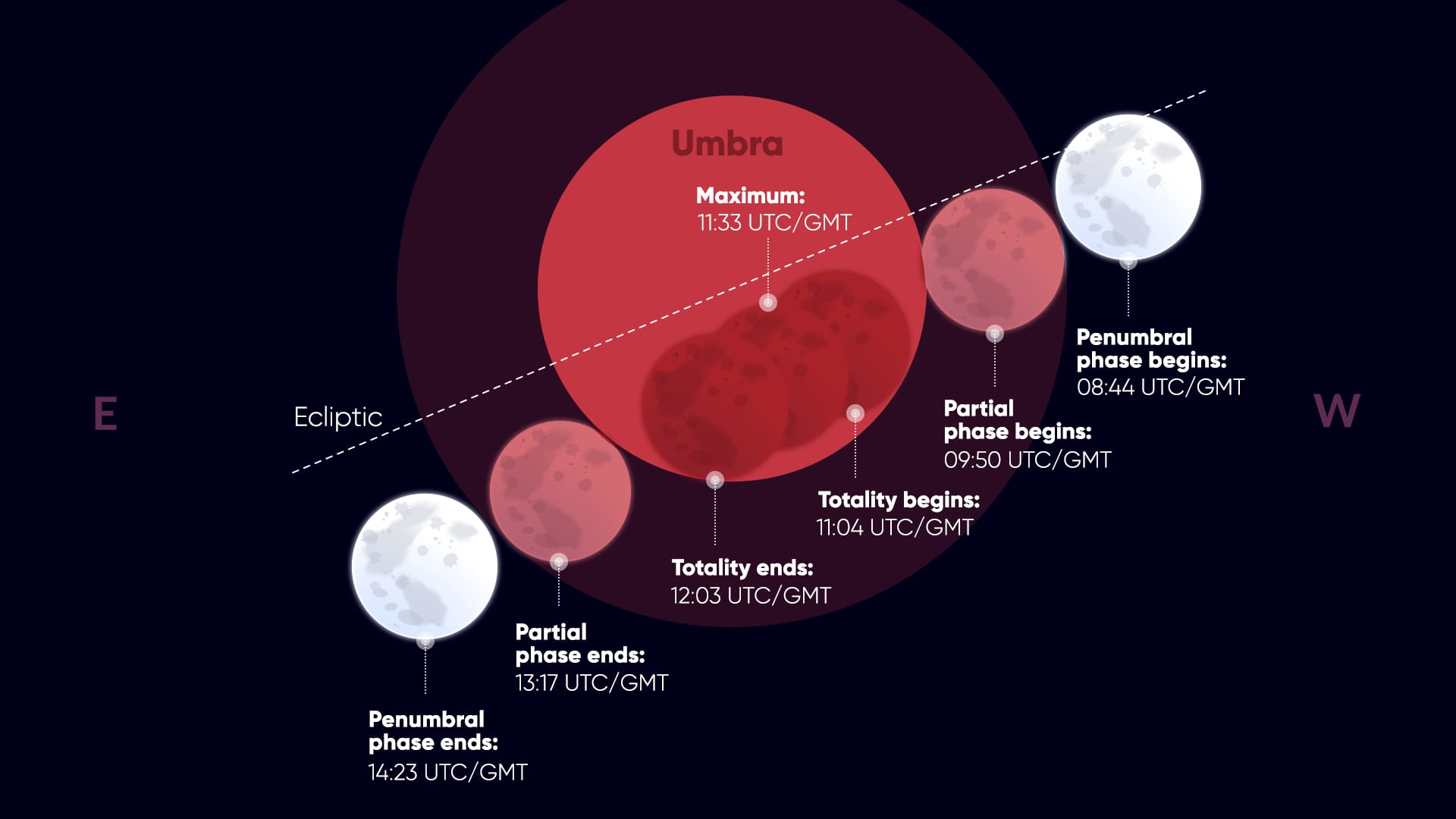
| Total Lunar Eclipse Phase | UTC | HST (Hawaii) | PST | EST |
| Penumbral Eclipse Begins Not much to see yet! The outer edge of the Earth’s shadow is called the penumbra. It is barely noticeable by the naked eye when the Moon passes through it. The light only dims by a couple of %. It’s not a particularly interesting part of a lunar eclipse. |
08:44 (Mar 3) |
10:44 pm (Mar 2) |
12:44 am (Mar 3) |
3:44 am (Mar 3) |
| Partial Eclipse Begins The real action begins when the bright full Moon begins to be covered by Earth’s darker shadow (umbra). The bright full Moon may appear white, but with a fuzzy shadow blocking part of it. |
09:50 (Mar 3) |
11:50 pm (Mar 2) |
1:50 am (Mar 3) |
4:50 am (Mar 3) |
| Total Eclipse Begins Start of the best part! The Moon is now entirely within the umbra — glowing a ghostly reddish copper. The Moon’s southern limb passes closest to the center of Earth’s shadow, producing a striking color gradient. |
11:04 (Mar 3) |
1:04 am (Mar 3) |
3:04 am (Mar 3) |
6:04 am (Mar 3)* |
| Greatest Eclipse The peak of the show! This is the deepest point, when the reddish color will be the most intense. The southern half will appear considerably darker and redder, while the northern limb shows coppery-orange tones. If you only have time to look at one part, this is what to aim for. |
11:34 (Mar 3) |
1:34 am (Mar 3) |
3:34 am (Mar 3) |
6:34 am (Mar 3)* |
| Total Eclipse Ends Start watching the transition back to a white Moon! The total eclipse ends when the edge of the Moon starts to emerge out of the full shadow (umbra) and into the lighter shadow (penumbra). The reddish color begins to disappear. The bright full Moon may appear white, but with a fuzzy shadow blocking part of it. Now the partial eclipse phase begins again. |
12:03 (Mar 3) |
2:03 am (Mar 3) |
4:03 am (Mar 3) |
7:03 am (Mar 3)* |
| Partial Eclipse Ends The show is over for most sky watchers! The Moon has moved completely out of the Umbra. If viewing with your naked eye, this is a good place to stop watching. The Moon will be moving through the penumbra, but it is difficult to see this, as the light change is only a few %. |
13:17 (Mar 3) |
3:17 am (Mar 3) |
5:17 am (Mar 3) |
8:17 am (Mar 3)* |
| Penumbral Eclipse Ends Not much to see here! The official eclipse is over when the Moon completely leaves the outer edge of the Earth’s shadow. |
14:23 (Mar 3) |
4:23 am (Mar 3) |
6:23 am (Mar 3) |
9:23 am (Mar 3)* |
* Moon may be setting or below the horizon for eastern locations. Check your local moonset time!
To find out the eclipse times for your location check out timeanddate.com.
What is a lunar eclipse?
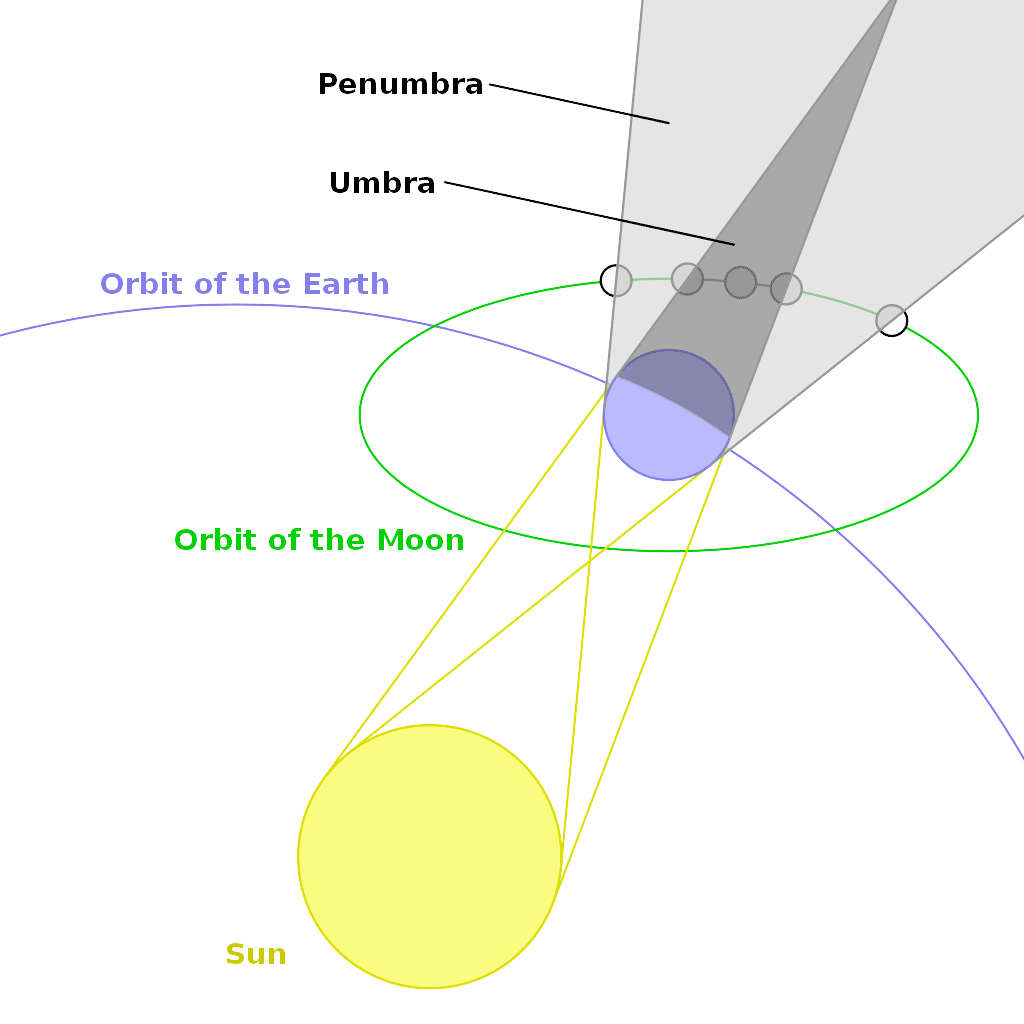
Earth’s shadow can be divided into two distinctive parts: the umbra and penumbra.
Earth totally occludes direct solar radiation within the umbra, the central region of the shadow. However, since the Sun’s diameter appears about one-quarter of Earth’s in the lunar sky, the planet only partially blocks direct sunlight within the penumbra, the outer portion of the shadow.
Within the umbra, the central region, the planet totally shields direct sunlight. In contrast, within the penumbra, the outer portion, the sunlight is only partially blocked.
In the diagram, the Sun, Moon, and Earth sizes nor the distances between the bodies are to scale.
🚀 The Science Behind the Red Glow 🔴
Why does the Moon turn red?
The key is Rayleigh scattering. As sunlight passes through Earth’s atmosphere, shorter wavelengths (like blue light) scatter, leaving the longer wavelengths (like red) to illuminate the Moon. 🌇 This causes the Moon to glow in shades of orange and red. 🧡❤️
It’s a truly magical sight! 🌟
The Moon is red during a total lunar eclipse because of the same effect that creates sunrises and sunsets.
Colors of shorter wavelengths like blue are scattered more by Earth’s atmosphere than the longer wavelengths like red. When the Sun is low in the sky during sunrise and sunset the light travels through more atmosphere so more of the blue light is scattered leaving more red light. When Earth blocks the light from the Sun during a lunar eclipse the edge of Earth has a glow like a sunrise or a sunset from the scattered light in the atmosphere. This is what gives the shadow on the Moon during the total eclipse its reddish tint.
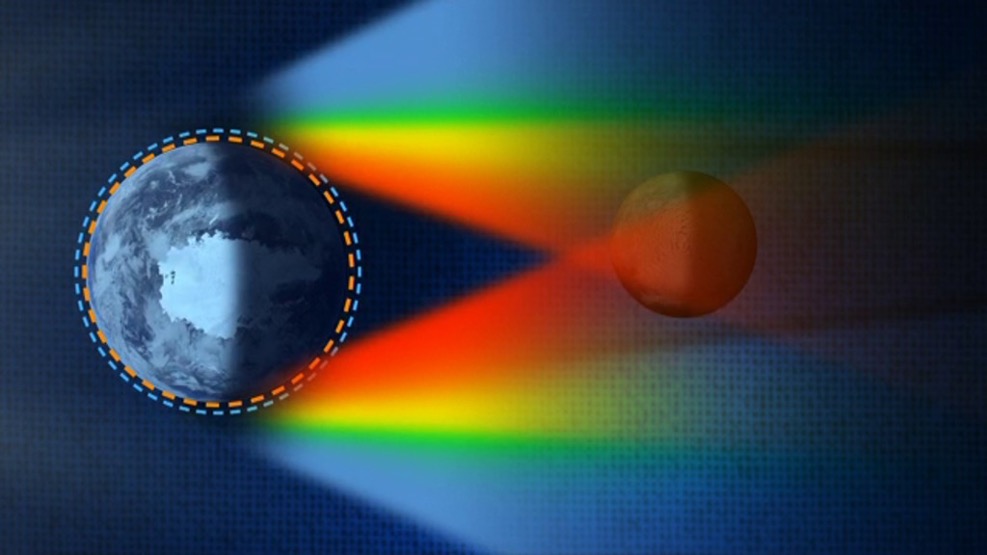
During a lunar eclipse, Earth’s atmosphere scatters sunlight. The blue light from the Sun scatters away, and longer-wavelength red, orange, and yellow light pass through, turning our Moon red. *This image is not to scale. Credit: Goddard Space Flight Center/Scientific Visualization Studio
🎨 What Will This Eclipse Look Like?
This eclipse will be especially beautiful because of an asymmetric shadow passage. The Moon’s southern limb passes closest to the center of Earth’s shadow (just 4.1 arc minutes from the axis!), which means:
- 🔴 The southern half of the Moon will appear considerably darker and redder
- 🟠 The northern limb will be noticeably brighter, potentially showing coppery-orange or even yellowish tones
- 🎨 The result is a striking color gradient across the lunar disk — one of the most photogenic effects in eclipse watching!
The expected Danjon brightness is around L ≈ 2 to L = 3 — a deep red to brick-red Moon, assuming no major volcanic eruptions have injected aerosols into the stratosphere. Observers are encouraged to submit Danjon brightness estimates to Sky & Telescope and Dr. Richard Keen (University of Colorado) for ongoing atmospheric opacity studies. 📊
🔭 Bonus: Galaxy Occultation During Totality!
Here’s a rare treat for astrophotographers: during totality, the Moon will occult the galaxy NGC 3423 as seen from North America! 🌌 A deep-sky occultation during a total lunar eclipse is an extremely unusual event — the darkened Moon creates unique imaging opportunities that simply aren’t possible under normal full-Moon conditions. Break out those telescopes and cameras! 📸✨
⚠️ Mark Your Calendars — Next One Isn’t Until 2029!
This total lunar eclipse completes an extraordinary streak of three consecutive total lunar eclipses (March 2025 → September 2025 → March 2026). After this, the next total lunar eclipse won’t occur until December 31, 2028 / January 1, 2029 — a gap of nearly three years. If you can see this one, make the effort! 🗓️✨
🌿 The End of a Streak
This eclipse completes a remarkable run of three consecutive total lunar eclipses spanning just one year:
- 🌕 March 13–14, 2025 — Total lunar eclipse
- 🌕 September 7–8, 2025 — Total lunar eclipse
- 🌕 March 3, 2026 — Total lunar eclipse ← You are here!
After this, a partial lunar eclipse follows on August 28, 2026 — making this almost (but not quite) a tetrad. The next total lunar eclipse won’t arrive until the very last night of 2028. Savor this one! 🥂🌑
Eclipse Season: What Is It?
Did you know that eclipses don’t just happen randomly throughout the year? They occur in what’s called Eclipse Season! 🌑✨
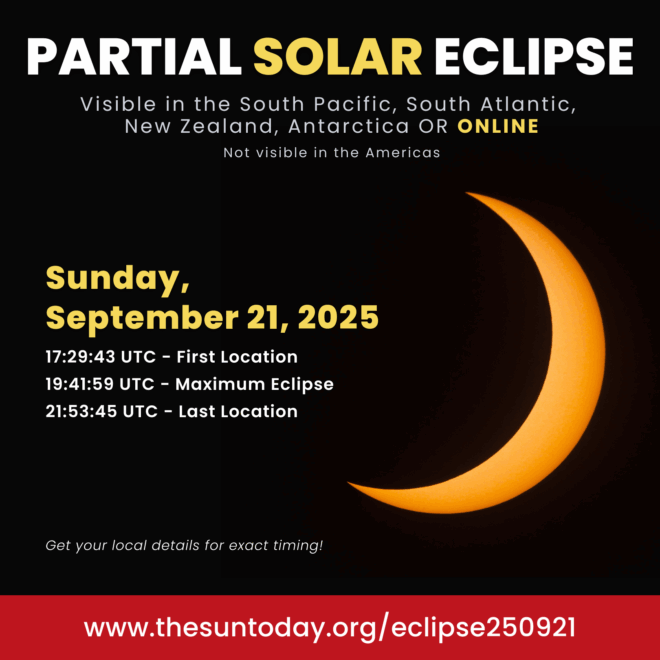
Eclipse seasons are windows of time when the Sun, Earth, and Moon align just right to create eclipses. Each season lasts for about 34 to 38 days and occurs roughly every six months. During this period, there are typically two eclipses—one solar and one lunar—because of the way the Moon’s orbit intersects the Earth’s orbital plane (called the ecliptic).
The first eclipse season of 2026:
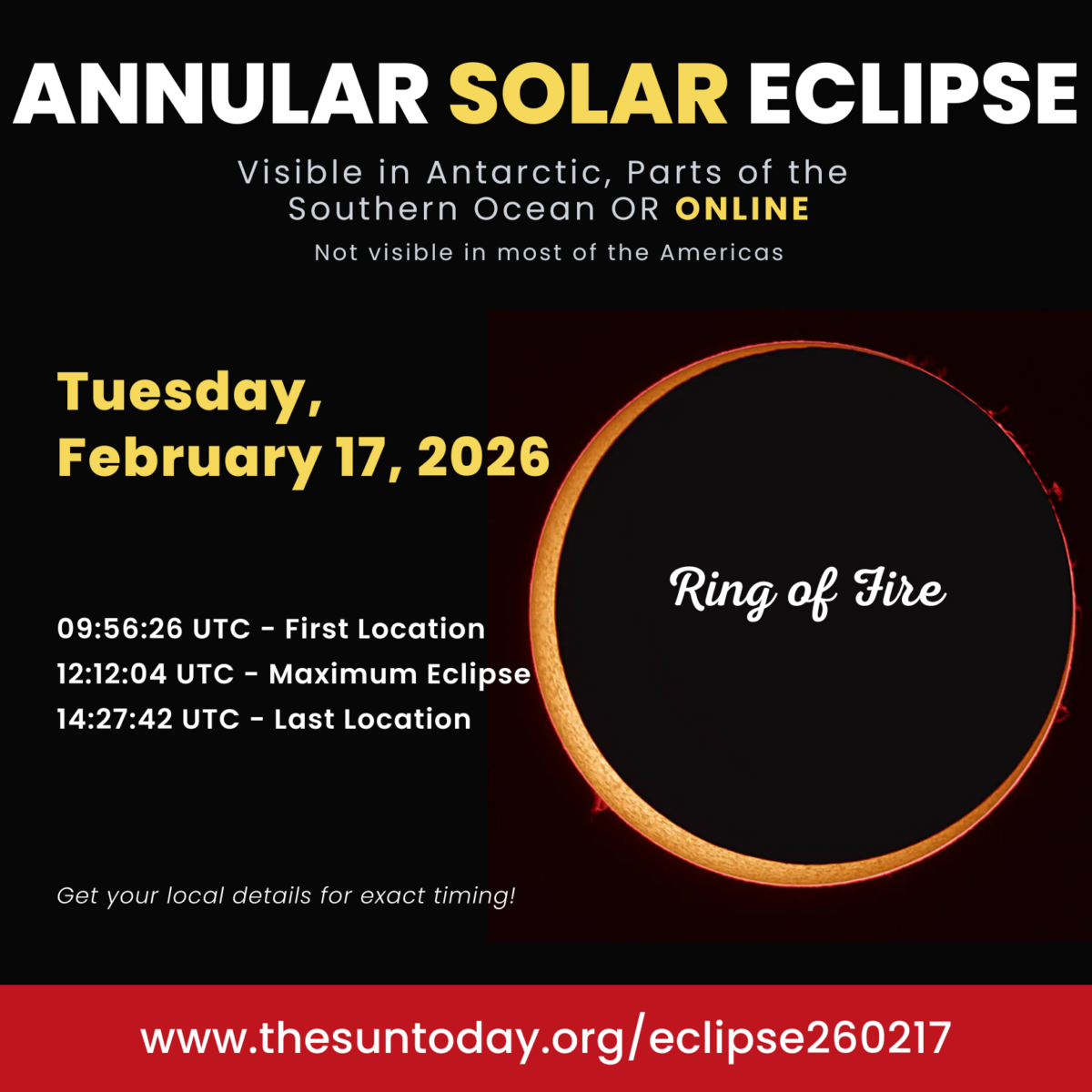
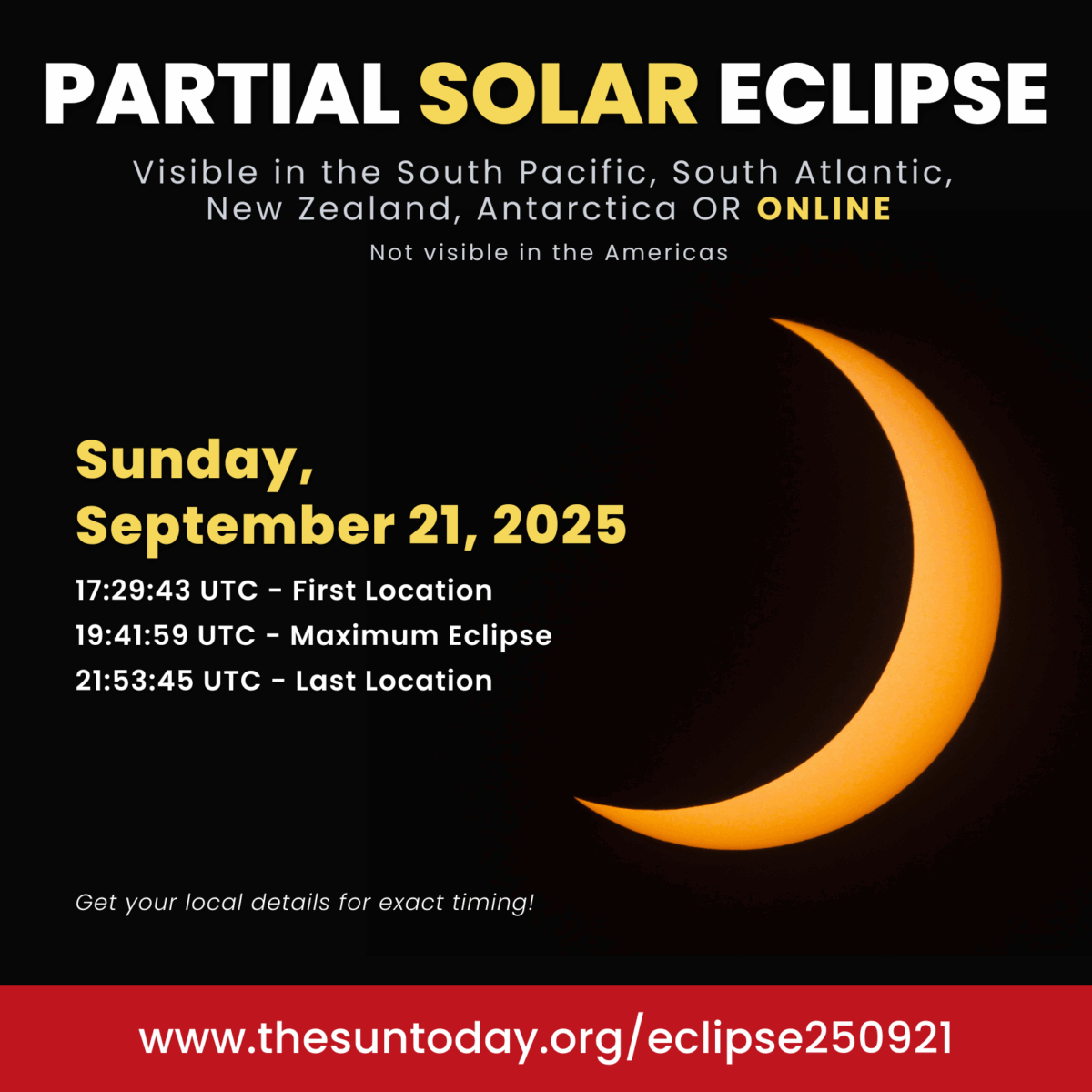
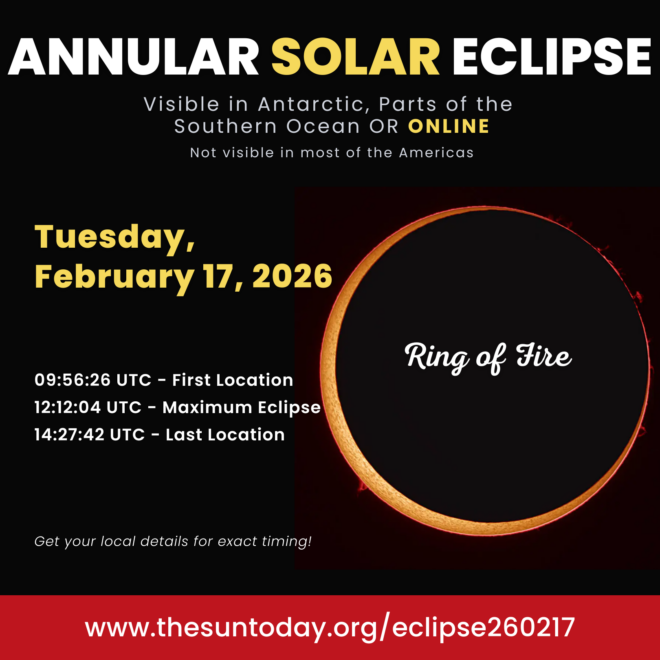
- Annular Solar Eclipse on February 17, 2026 ☀️💍: An extraordinary “ring of fire” eclipse confined almost entirely to Antarctica — one of the most remote central eclipses in modern history. Only a handful of researchers will witness annularity in person!
- Total Lunar Eclipse on March 3, 2026 🌕🌑: A spectacular Blood Moon visible across the Pacific Rim, with nearly an hour of totality. This is the last total lunar eclipse until late 2028!
A second eclipse season occurs later in 2026:
- Total Solar Eclipse on August 12, 2026 ☀️🌑: The headline eclipse of the year! Totality sweeps from Greenland across Iceland to Spain — the first European totality in over a decade. Mark your calendars — this is the big one! 🇮🇸🇪🇸
- Partial Lunar Eclipse on August 28, 2026 🌕🌗: Visible across the Americas, , Africa, and Asia.
Don’t miss out on these cosmic spectacles, either in person or watching online! 🌞🌑
The March 2026 Full Moon Timing 🌕 ⏰
How long is the Moon 100% Full?
- The Full Moon phase itself lasts only a brief moment — a few minutes when the Moon is exactly opposite the Sun.
- The Full Moon occurs at approximately 11:34 UTC on Tuesday, March 3, 2026 — coinciding almost exactly with greatest eclipse! At this exact time, the Moon is 100% full.
- The Moon is 100% full for about 1–2 minutes — from 11:34 UTC to approximately 11:36 UTC (a very short time, given the precision of the alignment).
- After 11:34 UTC, the Moon begins to move slightly out of alignment, and it will no longer be exactly opposite the Sun. It will drop to approximately 99.9% full in the next few minutes, and the full illumination will start to decrease gradually.
After Full Moon – Declining Brightness:
- After this exact moment of Full Moon (when it’s 100% illuminated), the Moon starts to move along its orbit, and the illumination fraction decreases.
- By 11:38 UTC, the Moon has already lost a fraction of its full brilliance, down to around 99.9% illumination, and the decline continues steadily.
So, the timeline looks something like this:
- 11:34 UTC: Full Moon (100% illumination) for about 1–2 minutes.
- 11:36 UTC: 99.9% full.
- 11:38 UTC: Brightness continues to decline, and the Full Moon glow begins its slow fade.
- I’m using UTC here because this time zone best serves the global viewing audience for this eclipse.
🌕 March 3, 2026 — Lunar Eclipse Parameters 🌑
| Event | Time (UTC) |
|---|---|
| Penumbral Eclipse Begins | 2026 Mar 3 — 08:43:58 |
| Partial Eclipse Begins | 2026 Mar 3 — 09:49:37 |
| Total Eclipse Begins | 2026 Mar 3 — 11:03:54 |
| Greatest Eclipse | 2026 Mar 3 — 11:33:40 |
| Total Eclipse Ends | 2026 Mar 3 — 12:02:53 |
| Partial Eclipse Ends | 2026 Mar 3 — 13:17:26 |
| Penumbral Eclipse Ends | 2026 Mar 3 — 14:23:19 |
| Parameter | Value |
|---|---|
| Penumbral Magnitude | 2.18580 |
| Umbral Magnitude | 1.15263 |
| Gamma | −0.37651 |
| Totality Duration | 58 minutes 59 seconds |
| Partial Duration | 3 hours 27 minutes 49 seconds |
| Penumbral Duration | 5 hours 39 minutes 21 seconds |
| Moon Right Ascension | 10h 56m 15.0s |
| Moon Declination | +06°24′05.3″ |
| Moon Semi-Diameter | 15′37.0″ |
| Moon Equatorial Horizontal Parallax | 0°57′18.7″ |
| Constellation | Leo (near Regulus) ♌ |
| ΔT | 72.1 s |
📚 For lunar eclipses, the penumbral magnitude measures how deep the Moon goes into Earth’s faint outer shadow, while the umbral magnitude (1.153) shows how much enters the darker, central shadow. A value above 1.0 means the Moon is fully immersed — that’s what makes this a total lunar eclipse! 🌕✨
🔄 Saros 133: A Young Series of Deep Totals ⏳
This eclipse belongs to Lunar Saros 133 — a family of eclipses that began with a penumbral eclipse on May 13, 1557 and will continue until around June 29, 2819 — a span of 1,262 years! This is member 27 of 71 in the series, meaning Saros 133 is still relatively young and in its prime total-eclipse phase (1917–2278).
The series hasn’t even reached its peak yet — the longest totality of 101 minutes 41 seconds won’t arrive until May 30, 2170! The previous eclipse in this family was the total lunar eclipse of February 20–21, 2008, and the next will be March 13–14, 2044. 🔮
🌕🔴🌑 Blood Moon
A Blood Moon occurs during a total lunar eclipse, when the Earth casts its shadow on the Moon, turning it a striking red hue. 🔴 The deep, rusty color appears as the Earth’s atmosphere bends sunlight, filtering only the red wavelengths, which paint the Moon’s surface. 🌑🌕 The Blood Moon is a symbol of transformation, where old cycles end and new beginnings are ushered in under its hauntingly beautiful glow. 🌕🔴
Beyond the Science…
🪱🌕 Worm Moon
The Worm Moon is the March full moon, marking the time when earthworms begin to emerge from the thawing ground as winter loosens its grip. 🪱🌱 This moon signals the start of spring’s slow awakening — when the soil softens, birds return, and the first green shoots push through. Across many cultures, the March full moon has carried names tied to this seasonal transition: the Crow Moon (when crows signal the end of winter), the Sap Moon (when maple sap begins to flow), and the Crust Moon (from the crust that forms on snow as it melts and refreezes). 🍁❄️🌿
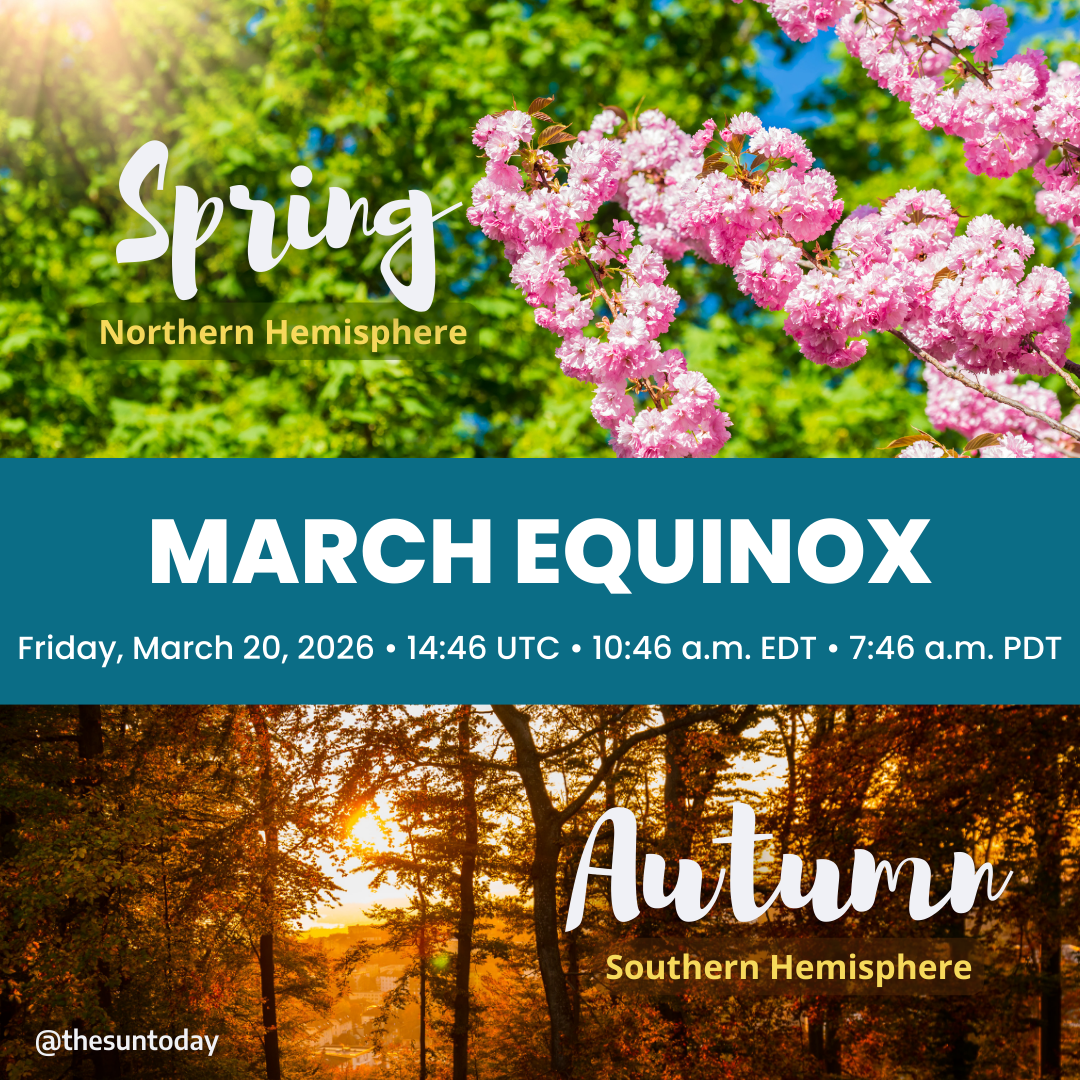
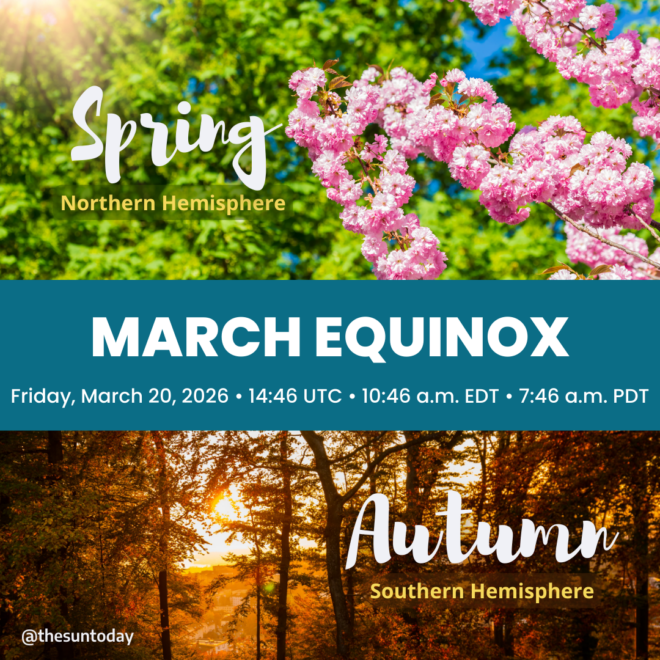
In 2026, the Worm Moon arrives with a cosmic flourish — turning blood red during this total lunar eclipse before the spring equinox on March 20. It’s a powerful transition from winter darkness to spring light. 🌕🌑🌸
Here are some other names for the March Full Moon:
| Name | Culture/Region | Origin/Meaning |
| Worm Moon | Indigenous (Algonquin, Eastern Woodlands) |
Named for the earthworms that emerge as the ground thaws, signaling spring’s arrival. |
| Crow Moon | Indigenous (Various Tribes) |
The cawing of crows signals the end of winter. |
| Sap Moon | Indigenous (Algonquin) |
When maple sap begins to flow and tapping season begins. |
| Crust Moon | Indigenous (Various Tribes) |
Snow develops a crust from thawing and refreezing. |
| Lenten Moon | Christian Tradition | Falls during the season of Lent, a period of reflection and preparation. |
| Chaste Moon | Medieval European | Associated with purity and the cleansing transition from winter to spring. |
| Storm Moon | Old European Tradition | Marks the last stormy weather of winter before calmer spring arrives. |
| Wind Moon | Celtic Tradition | Refers to the strong March winds that usher in the change of season. |
| Plough Moon | Anglo-Saxon | Signals the time to begin ploughing fields for spring planting. |
🌕 Worm Moon Eclipse: A Night of Transformation 🌑
On the night of March 3, 2026, the Worm Moon will bring not just its silvery glow but also the last total lunar eclipse for nearly three years. For observers across the Pacific Rim — from Tokyo to Honolulu, from to Anchorage — this is a night to step outside and look up. 🌏✨
🌿 Astrological Vibes: Release & Renewal
Eclipses are often seen as cosmic turning points — moments to clear out what no longer serves us and invite in growth and transformation. 🌱💫 As this lunar eclipse in Leo unfolds, it encourages us to step into our authentic selves, express creativity, and release what holds us back from shining. With the Pisces Sun across the sky, the message is about balance — pairing bold self-expression with compassion and spiritual depth. 🦁✨
🌟 Cosmic Reset: Winter to Spring
With the spring equinox arriving just 17 days later on March 20, this Blood Moon marks a powerful seasonal transition. Ancient cultures viewed eclipses as moments of transformation — the temporary darkening of the Moon followed by its return to full brightness echoing the cycle of winter giving way to spring. 🌑➡️🌕🌸
🌠 Look Up & Connect
Whether you’re watching from a Hawaiian beach, an Alaskan mountainside, a Japanese rooftop, or a cozy Australian backyard, you can join in the collective awe. Ancient cultures viewed eclipses as sacred events, charged with divine energy. Today, we can honor that same tradition by pausing, looking up, and connecting — whether through livestreams, meditation, or simply stepping outside to feel the night sky’s quiet power. 🌙💻💫
🌸 From Worm Moon to Equinox
This eclipse falls during the Worm Moon, March’s full moon tied to the first stirrings of spring. 🪱 With the equinox on March 20 just around the corner, this Blood Moon eclipse marks a powerful seasonal reset — a moment of release before the balance of light and dark shifts toward longer, warmer days. It’s a chance to clear the ground before new growth begins. 🌕🌱🌸
The world is chaotic, so let’s hope you can pause and do a personal reset, if only for a moment.