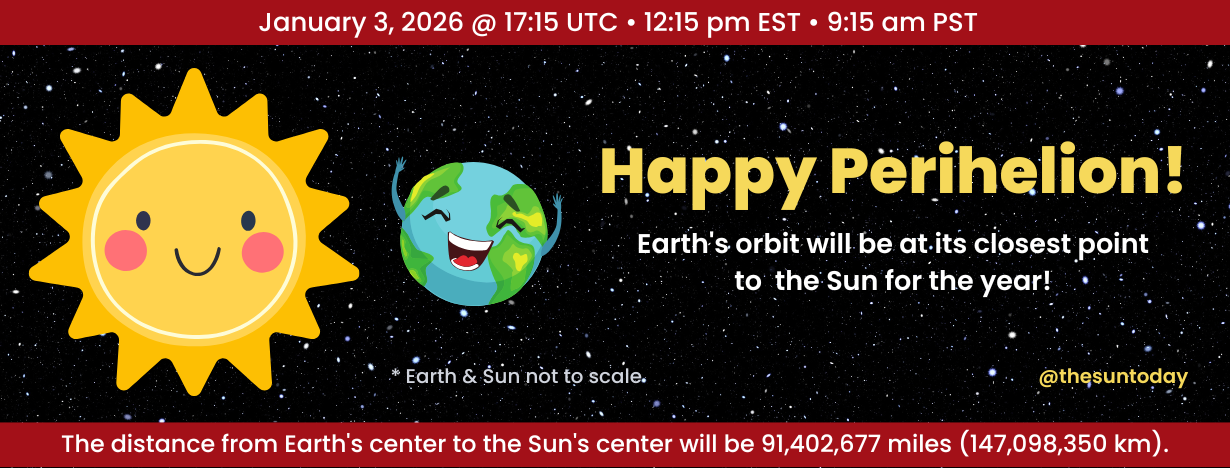
Every January, our planet reaches a cosmic milestone — perihelion — the point in its orbit where Earth is closest to the Sun. The word “perihelion” comes from Greek, meaning “near the Sun.”
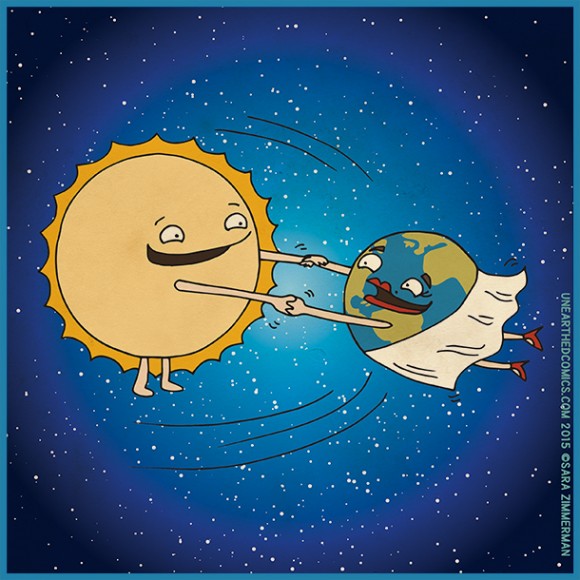
A cartoon of the Sun swinging Earth. Earth orbiting around the Sun. credit: Cartoon via Sara Zimmerman at UnEarthed Comics. (shared by Earthsky.org)
📅 When Is It?
In 2026, Earth reaches perihelion on January 3, 2026 at about 17:15 UTC (12:15 p.m. EST). At that moment, Earth will be approximately 91.4 million miles (147.1 million km) from the Sun — about 3 million miles closer than at its farthest point (aphelion).
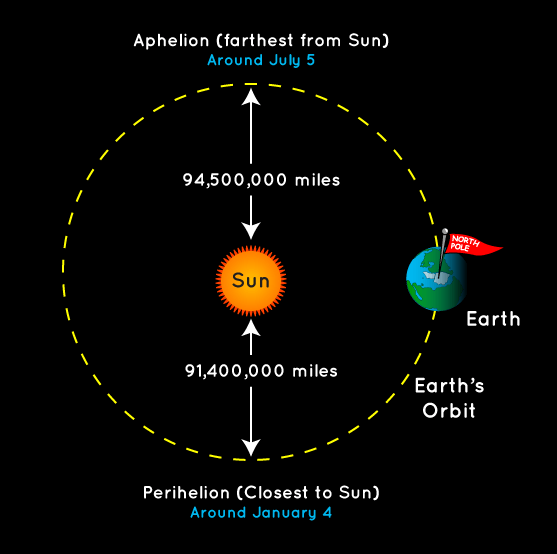
Perihelion and Aphelion diagram from Space Place
☀️ What Perihelion Means
Earth travels in an elliptical (oval-shaped) orbit around the Sun. This shape causes the distance between Earth and the Sun to change over the year.
Earth’s closest point — perihelion — happens in early January, while its farthest point — aphelion — falls in early July.
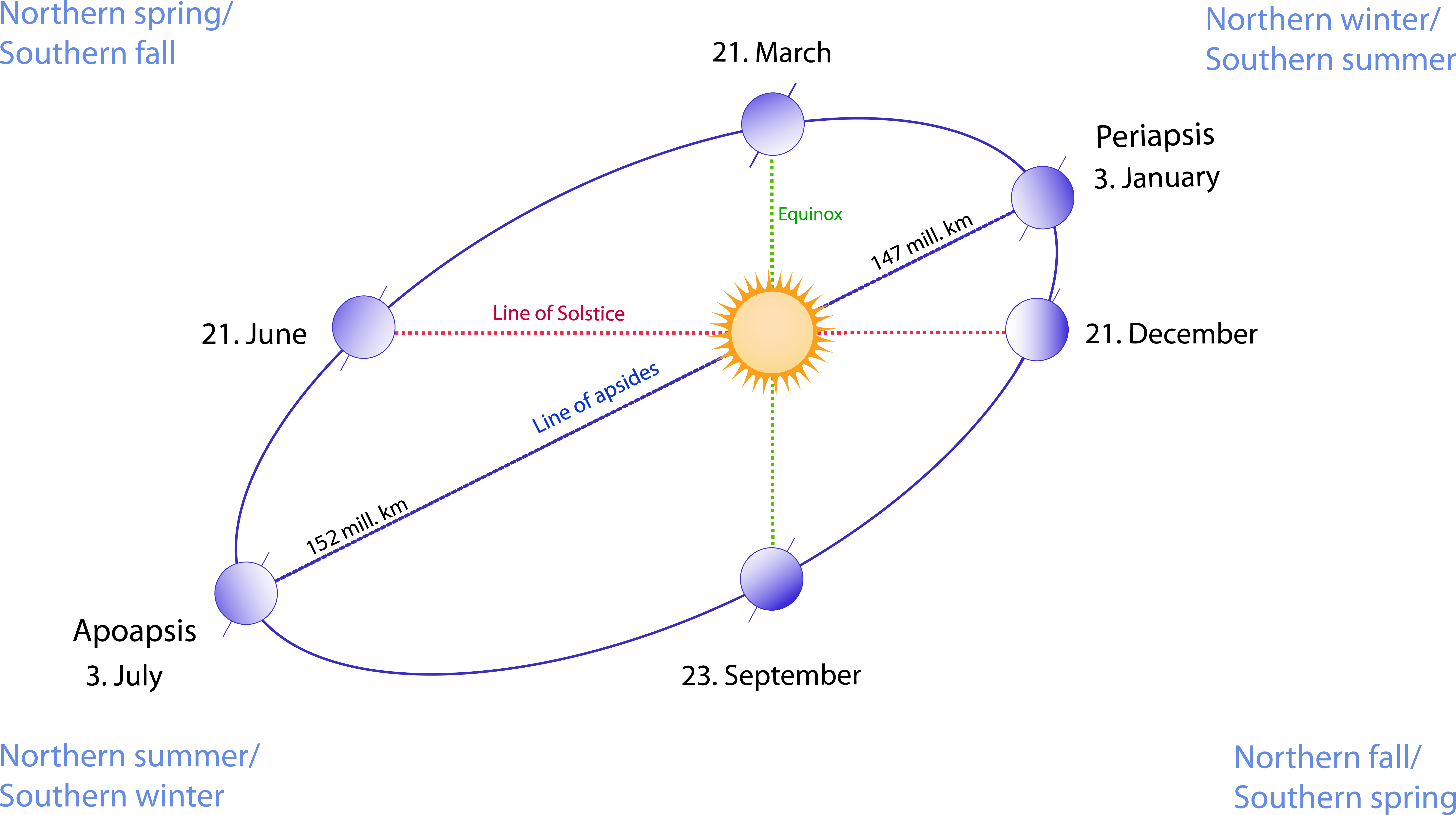
This diagram shows the relation between the line of solstice and the line of apsides of Earth’s elliptical orbit. The orbital ellipse (with eccentricity exaggerated for effect) goes through each of the six Earth images, which are sequentially the perihelion (periapsis—nearest point to the sun) on anywhere from 2 January to 5 January, the point of March equinox on 20 or 21 March, the point of June solstice on 20 or 21 June, the aphelion (apoapsis—farthest point from the sun) on anywhere from 4 July to 7 July, the September equinox on 22 or 23 September, and the December solstice on 21 or 22 December. Credit: Wikipedia
🌡️ Seasons — Tilt Beats Distance
You might think being closer to the Sun would make winter warmer — but that’s not the case! Seasons are dictated by Earth’s 23.5° axial tilt, not the distance to the Sun. That’s why it’s still winter in the Northern Hemisphere at perihelion.

The Sun is directly overhead at “high-noon” on December Solstice at the latitude called the Tropic of Capricorn.
🚀 Fun Facts About Perihelion
🔥 1. Solar Energy Is Slightly Higher
At perihelion, Earth receives about 7% more solar energy than at aphelion — a measurable boost, but not enough to control seasons.
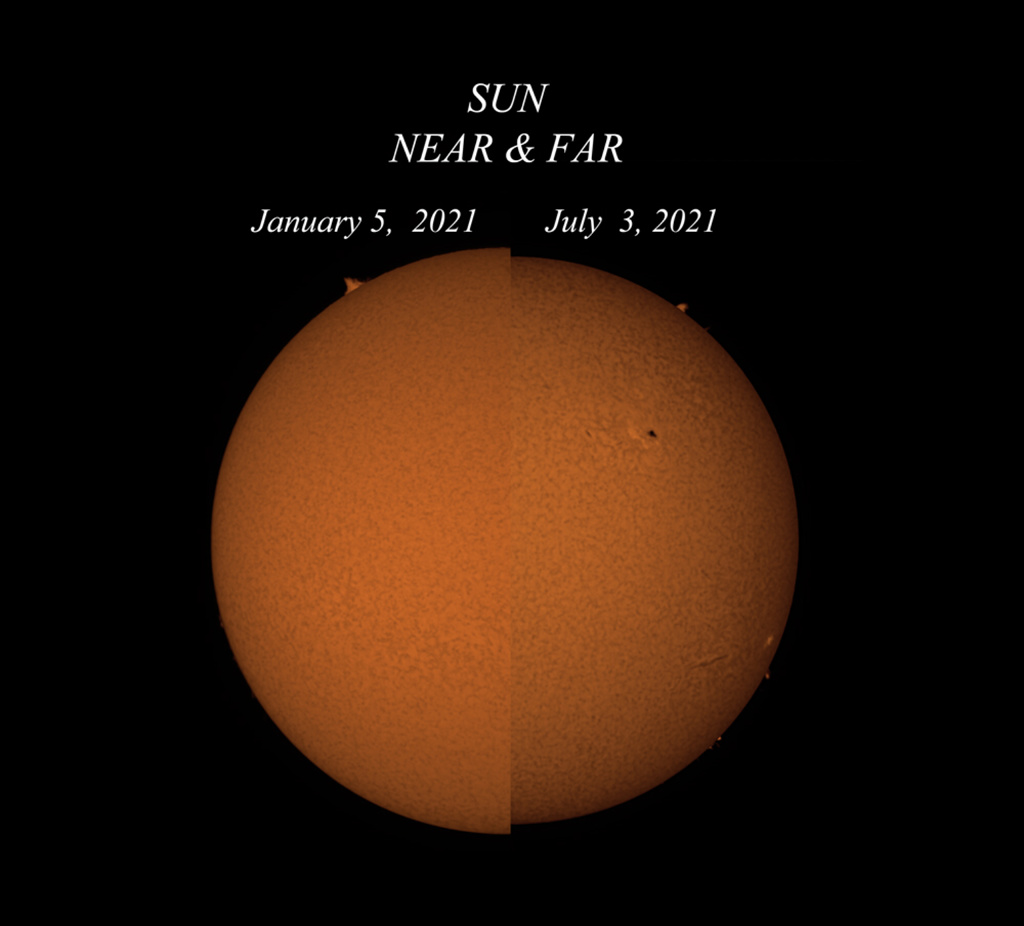
🌞 “ Aphelion for 2021 occurred on July 5th. That’s the point in Earth’s elliptical orbit when it is farthest from the Sun. Of course, the distance from the Sun doesn’t determine the seasons. Those are governed by the tilt of Earth’s axis of rotation, so July is still summer in the north and winter in the southern hemisphere. But it does mean that on July 5 the Sun was at its smallest apparent size when viewed from planet Earth. This composite neatly compares two pictures of the Sun, both taken with the same telescope and camera. The left half was captured close to the date of the 2021 perihelion (January 2), the closest point in Earth’s orbit. The right was recorded just before the aphelion in 2021. Otherwise difficult to notice, the change in the Sun’s apparent diameter between perihelion and aphelion amounts to a little over 3 percent.” Credit: Richard Jaworski, shared by Astronomy Picture of the Day
💨 2. Earth Moves Faster
According to Kepler’s laws, Earth speeds up in its orbit as it gets closer to the Sun. That means just after perihelion, Earth is zipping along a bit faster than other times of year.
🪐 3. All Planets Have Perihelia
Every planet (and many comets) have perihelion points in their orbits. Mercury’s orbit is much more eccentric, making its perihelion much more dramatic than Earth’s.
Planetary Perihelion Distances
| Planet | Perihelion Distance (AU) | Perihelion Distance (Million km) |
|---|---|---|
| Mercury | ~0.307 AU | ~46.0 million km |
| Venus | ~0.718 AU | ~107.5 million km |
| Earth | ~0.983 AU | ~147.1 million km |
| Mars | ~1.38 AU | ~206.7 million km |
| Jupiter | ~4.95 AU | ~740.5 million km |
| Saturn | ~9.04 AU | ~1,352.5 million km |
| Uranus | ~18.3 AU | ~2,741.5 million km |
| Neptune | ~29.8 AU | ~4,459.0 million km |
| * AU = Astronomical Unit; 1 AU is the average distance between Earth and the Sun (~149.6 million km). * Perihelion is the point in a planet’s orbit closest to the Sun; planets move fastest at perihelion and slowest at aphelion due to orbital mechanics. :contentReference[oaicite:1]{index=1} |
||
📅 4. It Shifts Over Time
The timing of perihelion shifts very slowly over centuries due to gravitational nudges and orbital cycles called Milankovitch cycles.
🔭 Why It’s Attention-Worthy
Perihelion reminds us of our place in the dynamic solar system. It reflects how gravitational interactions and orbital mechanics shape Earth’s journey through space — even if the effects on our weather are subtle.
Science communicator Dr. James O’Donoghue creates amazing visuals. He created two visuals to illustrate the reasons for the seasons, solstices, and equinoxes.
During perihelion the Sun may appear about 3% larger in the sky, though this is not noticeable without precise instruments.
While the 2025 perihelion is a routine astronomical event, it underscores the relationship between Earth’s orbit, axial tilt, and seasonal differences between the hemispheres.
Differences Between the Northern and Southern Hemispheres
Earth’s seasons are not determined by its distance from the Sun but by its axial tilt. This is why, during perihelion—when Earth is closest to the Sun—the Northern Hemisphere experiences winter, while the Southern Hemisphere is in summer. Conversely, during aphelion—when Earth is farthest from the Sun—the Northern Hemisphere is in summer, and the Southern Hemisphere experiences winter.
Seasonal Timing
Northern Hemisphere Summer: From the June solstice to the September equinox.
Southern Hemisphere Summer: From the December solstice to the March equinox.
Orbital Impact on Seasonal Length
During Northern Hemisphere summer, Earth is at aphelion and moves more slowly in its orbit. This results in a longer summer and shorter winter.
During Southern Hemisphere summer, Earth is at perihelion and moves more quickly in its orbit, leading to a shorter summer and longer winter.
Due to these orbital dynamics, the Northern Hemisphere summer is approximately 4 days longer than the Southern Hemisphere summer.
Daylight and Latitude
Cities in the Northern Hemisphere receive more daylight over a year compared to the Southern Hemisphere. This difference arises from Earth’s tilt and orbital position. Around the Arctic and Antarctic Circles, the Sun’s path along the horizon causes noticeable variations in daylight patterns.
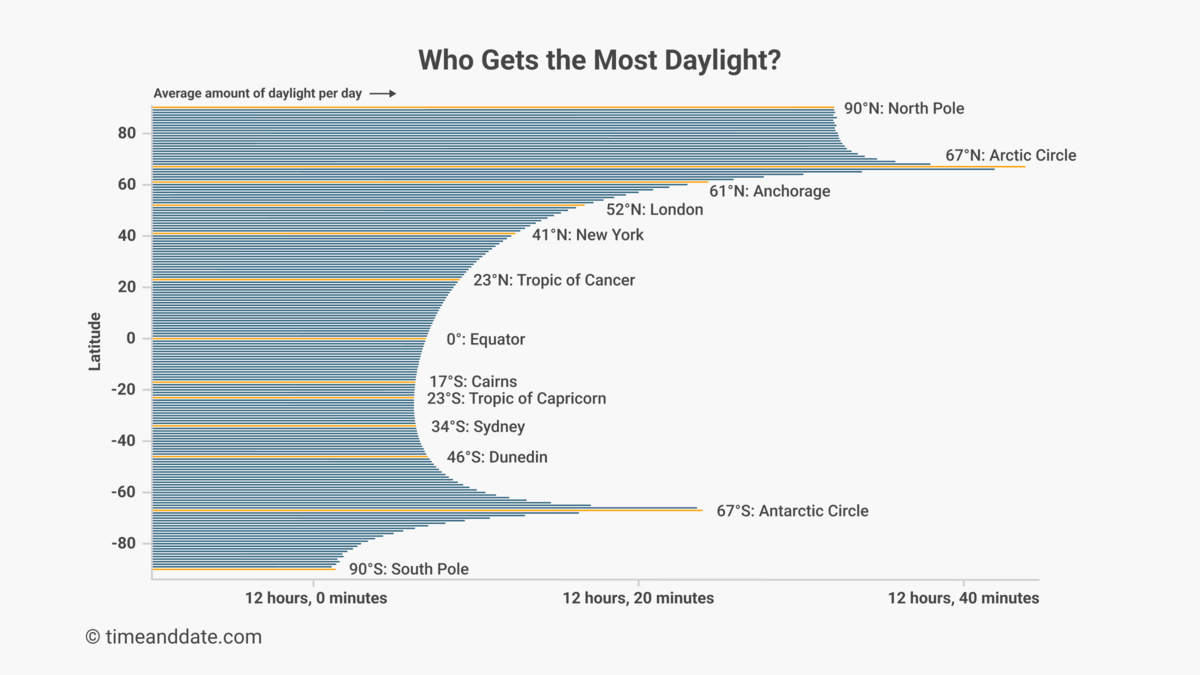
This bar chart shows the average amount of daylight per day, over the course of one year, for every line of latitude from the North Pole at 90° north, to the South Pole at 90° south. Consequences of aphelion: generally speaking, cities in the Northern Hemisphere get more daylight over the course of the year than cities in the Southern Hemisphere. The reason for the spikes around the Arctic and Antarctic Circles in the above chart is the way the Sun skims along the horizon in the polar regions. Image via timeanddate.com
Here are Earth’s perihelions and aphelions for 2026 through 2029.
| Year | Perihelion | Distance | Aphelion | Distance |
|---|---|---|---|---|
| 2026 | January 3, 2026 12:15 pm | 91,403,637 mi | July 6, 2026 1:30 pm | 94,502,962 mi |
| 2027 | January 2, 2027 9:32 pm | 91,406,556 mi | July 5, 2027 1:05 am | 94,510,857 mi |
| 2028 | January 5, 2028 7:28 am | 91,404,129 mi | July 3, 2028 6:18 pm | 94,506,289 mi |
| 2029 | January 2, 2029 1:13 pm | 91,402,677 mi | July 6, 2029 1:11 am | 94,509,351 mi |
| * All aphelion/perihelion times are in local Eastern time (ET). | ||||
Spacecraft Also Have Perihelion & Aphelions
Upcoming closest approaches to the Sun of note are:
- The next perihelion for NASA’s Parker Solar Probe, #26, is June 8, 2026.
- The next perihelion for ESA’s Solar Orbiter is March 3, 2026.
📌 Quick Perihelion 2026 Summary
- Date: January 3, 2026
- Time: ~17:15 UTC (12:15 p.m. EST)
- Distance from Sun: ~91.4 million miles / 147.1 million km
- Season: Still winter in Northern Hemisphere
- Effect on weather: Minimal — tilt dominates seasons!

🌟 Thanks for reading!